Showing posts with label soil. Show all posts

Friday, April 22, 2016

So It Begins.....

Warm and dry enough weather has allowed us to start working on our little homestead's most valuable resource, DIRT.  The first warm work day is always exciting-


We bought a plow off Craigslist recently that has helped us with turning spring soil.  This has been on our wish list since we got our small tractor.


The plow flips over a strip of ground instead of churning it like a tiller.  Once the soil is 'flipped' all plant growth (weeds and our Winter Rye here) that was on the top is now underneath a clump of soil, which will cause it to die and rot due to the lack of sunshine.  I hear it helps warm the soil quicker as well.  Almanzo said so in Farmer Boy anyway.


Little man whacking away at the ground-

We will let this sit for multiple weeks then break it up more with out rototiller while we add compost.  We also turned over another plot in the back of our property; it was pure sod and our rototiller would not have been as effective.  It would've just churned the grass around and likely left plenty in tact to survive.  We added a tarp for extra killing.  BE GONE GRASS!

We are planning to make this our sweet corn and gourd patch (gourds for making bird houses; this variety here).  If all goes well I hope to possibly paint and sell these.

Food is already making its way out of the ground.  We should have enough asparagus to make a dish THIS WEEKEND!

Seedlings continue to sprout!


Lots to do, lots to do.

Needless to say I am glad for the return of the warm spring sunshine.... and also because of these thingies just installed on our roof.

We recently had solar panels installed on the back of our house.  Our property apparently was a prime candidate for benefitting from solar panels due to the way the backside of our roof faces (towards the south).  We had multiple solar companies stop and try to get us to sign up with them.  We choose a local company and went with the buying option instead of renting them; that way we received the SRECS (Solar Renewable Energy Credits).  The loan for purchasing and installing will be paid off in 5 years from the energy savings and then we will make money from the SRECs.  If you have other questions about these let me know or better yet just talk to my husband. :)

Off to gather some eggs and check for the second time today if my carrots have come up.... because I have a patience problem.


Wednesday, April 29, 2015

BFForever! Dirt and Biochar.

If I could go back to sixth grade and enter that Modern Woodmen speech contest again, I would write that speech assignment I had about DIRT.  Well maybe.  My assignment, if I remember correctly, was to write a speech about the backbone of America.  My talented and nationally speech writer winning sister helped me with the speech (totally acceptable according to the rules), and it was about The Family being the backbone of America.  So I guess that's hard to replace.  BUT, if I were asked to write about another important backbone of America I would have chosen DIRT.

Dirt, or more properly referred to as soil, is a mixture of minerals, organic matter, gases, liquids and organisms that work together to SUPPORT LIFE.  It is pretty important stuff.  We need it to grow our food supply; plant and meat.  We need it to grow our fibers to make our clothes.  It filters our ground water.  Dirt is also the source of many of the antibiotics we use, such as Penicillin.  This is only the surface of dirt's important..... So dirt deserves respect.  Worms know where it's at-

So here is an important thing about dirt, when used or abused it stops doing it's job.  When used for growing plants it's nutrients are depleted, when stripped of vegetation and overwork the much needed top soil washes away, when contaminated it can harbor the contaminates and transfer them to the vegetation or ground water.  Dirt is meant to be treated better than, well, dirt.

Enter a BFF for dirt-

Biochar
What is Biochar? It is simply charcoal.  More specifically it is charcoal made with the purpose to be added to soil, to improve soil.  Biochar is made when something living/organic (for most people this is wood) is burned at very little oxygen.  Our wood stove insert can burn wood with low enough oxygen to make some biochar.  It looks like this-

As you can see it is not ash.  Wood ash (aka potash), which is rich in potassium, is also good for the garden once weathered but is chemically and physically different from Biochar.  (Remember burning stuff changes the physical and chemical composition of the item you are burning, depending on how you burn your item (high temps, low temps, etc.) affect the outcome of your item.  For some reason a few of my cooking disasters are coming to mind).
If you have a wood burning stove in your home that can burn very efficient at low oxygen you could get some biochar.  A better way to do it would be with something like this-
Please check out the many sources on the web on how to produce your own biochar.

Why Is It So Ridiculously Good?

First:  It helps soil do it's important job.
  • It holds essential nutrients in the soil longer.
    • Biochar actually 'absorbs' the nutrients, such as from a fertilizer or compost, and holds it in the soil which otherwise could wash away (i.e. nutrient leaching).  Less fertilizer used and less fertilizer washing into ground water is a good thing.
  • It retains water and microorganisms.
    • Biochar, being porous, helps soil retain water which could decrease the need for excess irrigation.  The pores also provide a healthy environment for the soil's needed microorganisms to live AND reproduce.  This makes dirt happy.  It helps the soil support the life within the soil. 
  • It helps aerate the soil and can improve soil structure.
    • Soil structure is super important, more on that here.  Our soil is very compact and, without such additives, too compact to grow root vegetables and even take in water.  (Yes, it is so compact water just runs off the surface.)  We rely on aerating additives such as compost and biochar to make our garden grow (how about you Mary, Mary quite contrary).  Oxygen in soil is important for the organisms living in it and plant roots need oxygen to sustain the plant.
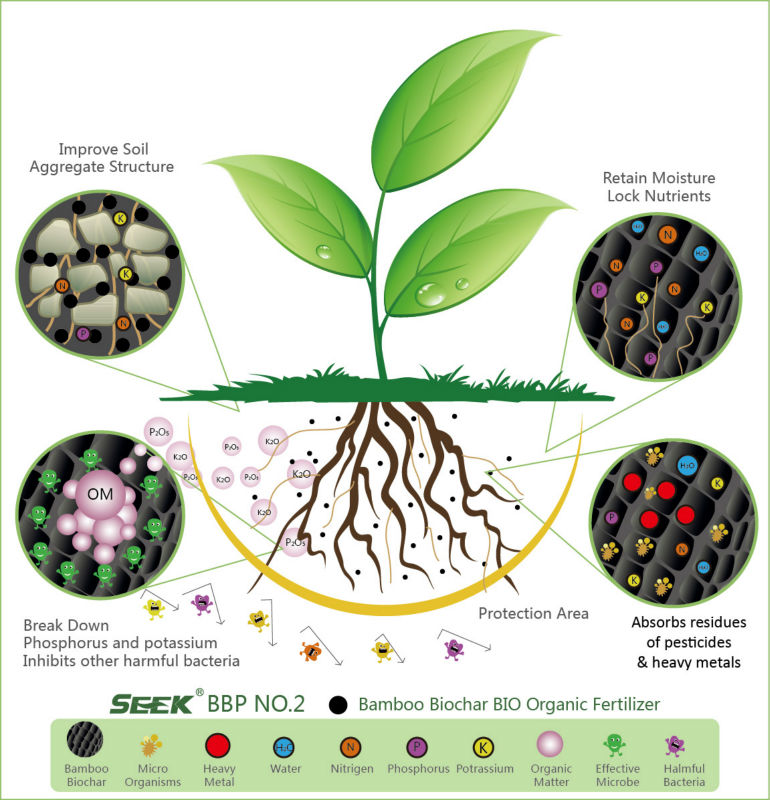
I choose this picture only because of the evil little bad bacteria, but it lists other good things about biochar-

Second:  Apparently it is also good for the environment.
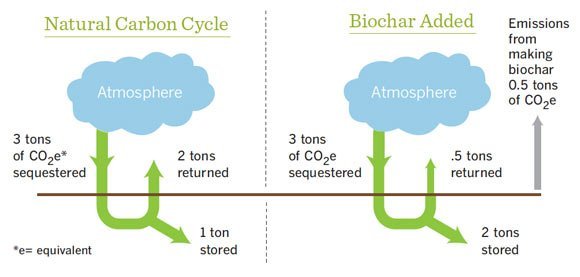
  • Biochar reduces green house gas emission into the atmosphere.
    • According to ALL the biochar resources out there, biochar holds carbon and other concerning 'green house gases' in the soil longer.  This is currently being researched more for helping lower carbon emissions into the atmosphere.  For more information on this, read HERE and HERE.
    • When animal waste is burned and made into biochar it reduces the methane gas (which is emitted naturally as waste decomposes) emissions into the atmosphere.
  • Biochar helps improve groundwater 
    • Biochar retains and holds fertilizers and/or other agrochemicals in the soil.  This keeps them accessible to the plant and keeps them from leaching into the groundwater.
Illustration from http://midwestpermaculture.com
-Quick note that biochar is NOT a new discovery, biochar has been discovered in soil in the Amazonian Basin back around 450 BC and AD 950.  Source of that tidbit is HERE: Terra Preta.

http://www.biochar.info/52/pix/comparison_biocharNpk_npk.jpg

So in conclusion, I will now summarize how we make biochar at our house: 

Step 1.  We get cold and burn wood in our wood stove on low oxygen.  I get warm and happy.
Step 2.  Our wood stove box starts overflowing with charcoal so much we have to clean it out.
Step 3.  We realize we made biochar for the garden and try to remember to store it somewhere outside where we can find it in the spring.
Step 4.  Spring comes and we find our accumulated biochar.
Step 5.  It is chunky and needs to be crushed, so Jonathan finds another use for his tractor.  (He runs over the biochar with it).


Step 6. We mix it with our compost (all our food scraps, dead leaves and animal droppings from past seasons).


Step 7.  We turn it in with the garden soil and plant stuff.  We use a organic fertilizer a few times during the season.

Step 8.  We watch our tomato plants get taller than us and wonder why?


Step 9.  We pick tomatoes the size of our daughter's head and Jonathan reminds me it is because he added biochar.

Step 10.  We eat our food.  Winter comes and we get cold again.  So we start burning wood in our wood stove on low oxygen.  We get warm and happy.  Repeat cycle.


Wednesday, October 23, 2013

Cover Cropping and Sneaky Quinoa

Yes, our quinoa is sneaky!!  More importantly it IS actually growing in our garden (I initially thought it did not germinate because of the soil temperature).  Here is the not so intriguing story....

I ended my previous post with a picture of us clearing out the garden to plant a cover crop.


While pulling up the remaining turnips and beets I noticed a new, so I thought, weed consistently growing in a row.  I skeptically declared to Jonathan it was my quinoa knowing there are some weeds that look similar.  So we decided to leave it and see what happens.  Here is my possible red quinoa, or at the least something in the same family (like lamb quarters maybe)-


Picture from my seed packet, notice the leaves-

Another picture of a young quinoa plant from the internet-


Here is a picture of the possible impersonator, whose leaves are edible I believe.  Wild lambs quarters-


Anyway, this is all probably very boring to most so I apologize.  It's exciting to me.  If anyone has experience growing quinoa please feel free share any information.
Back to cover cropping and why we are doing it.  We had a good year of harvest which we think is mostly due to the addition of lots of organic matter (composted cow manure) to our garden.  It greatly improved our soil's quality, especially the once horrible soil structure.
Cover cropping is when you sow a specific crop to improve the soil's quality.  For us we chose Winter Rye (yes, like the grain you find in rye bread).


After tilling up the ground we spread the seed just as you would grass seed (I got the Winter Rye seed from our local garden store, it was the one recommended for our area).


Then per my Dad's suggestion (since he does this sort of thing very often), we ran over it with our tractor to mash it down into the dirt.  For a smaller area, a simple raking around to cover the seed will do.


Now we let it grow all winter long.
Why cover crop (also called green manure), even if you have a small garden?  Cover crop suppress weeds, builds productive soil (by adding nutrients and organic matter after being tilled in in the spring) and help control pests and diseases.  Winter Rye specifically grows nice deep roots which provide many benefits to the soil (erosion control plus compaction prevention and the addition of organic matter in soil once the plant is dead).  It also helps preserve the nitrogen content in the soil instead of it leaching away into the ground water.  Winter Rye will grow and germinate in near freezing temperatures.  After well established it is very hardy and can tolerate temperatures as low as -33 degrees Fahrenheit (there is a minus in front of that number).
The crop then gets worked into the soil in the spring.  I cannot speak to how hard or easy it is to work up on a small scale without a tiller.  I would assume some work with a hoe would probably turn it over fine?  I have been told in our area that the crop will get stunted in the winter keeping it from re-seeding, but have read you should mow or work it in the soil before it gets to a re-seeding point.  I do know you should turn over any garden (cover crop or no cover crop) multiple weeks before planting in the spring to allow anything growing there to rot.  I will let you know how this goes for us.

To end with something worth looking at, here is baby girl feeding the pigs pumpkin scraps while wearing a purple sparkly necklace (irrelevant but a better ending than cover cropping stories)-

Pigs love all things squash, and baby girl thinks they should be served in style I guess-

Tuesday, April 30, 2013

Ambitious Boy and Spring Tree Blossoms

A quick non-sense post.  I am about 3/4 done with a post about raising chickens and if its worth it.... for those who prefer to read stuff with purpose. :)


I like this boy's self initiative.  Five cubic yards of compost was dropped off the other day for improving our garden's soil structure.   Without any words little man grabbed his dump truck and did what he  thought needed to be done.  Watching those Mighty Machine shows has done some good, thanks Netflix.


Into the garden-


The spring trees are near full bloom all around our house.  We really like our huge weeping cherry.  Hoping the winter moths don't nibble on the leaves once the blooms drop like they did last year (it's too tall for us to treat ourselves).


The tree is taller than our two story house but the wispy branches make it little of threat in a high windstorm.


Atleast it gives me something nice to look at while hovering over the sink.

Hope to have the chicken post up very soon!