Showing posts with label pigs. Show all posts

Wednesday, June 8, 2016

The BIG PIG News of 2016

THE PIGS HAVE ARRIVED!  And here is why this is the most exciting pig year yet----

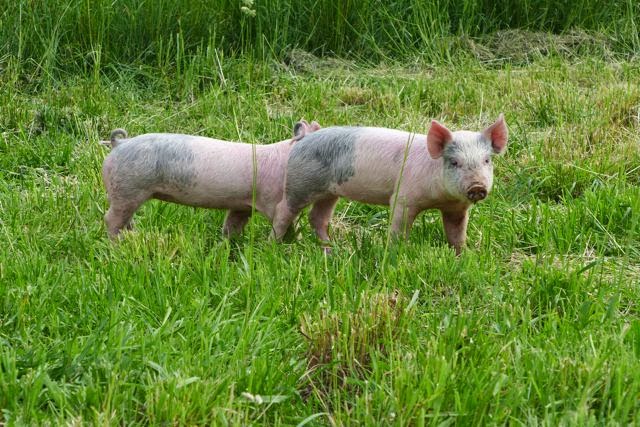
Two of these wee ladies will become long term residents on our little homestead!!

We will be keeping two girls, then soon purchasing a boar to start breeding and raising our own pigs.  We will sell some of their piglets but also keep some for raising for meat.

Why are we raising our own?
The main reason is we are striving for higher quality meat.  We put a lot of work, time and money into this yearly investment so it only makes sense to focus on the best end product possible.  All pork is not created equal.  Some pork is lean, some is more fat, some have darker meat, some have better hams, some make better bacon, some breeds have longer loins giving more cuts in that area.... the list goes on.  (The same goes for cattle and their beef as more are probably familiar with.  I myself was raised to love those Black Angus.)

Here's some pics of them before I go on-


The two girls we will be raising to become breeder sows are a purebred Hampshire and a purebred registered Mulefoot; both heritage breeds.  We will be breeding both to a purebred registered Mulefoot.


Hampshires are a very old breed of pig but very common still because of their many good qualities.  They are a very muscular and possibly THE leanest pig breed in North America.  Hampshires are known for excellent carcass quality, hardiness and the ability to forage for their food (a trait of most old breeds).  The Hampshires are the ones with the white belt around their shoulders.

Mulefoots are also a very old breed and actually endangered, it is the rarest swine breed in America!  They caught our eye as soon as we started researching them.  Mulefoot's meat is dark, marbled very nicely and apparently very flavorful.  It is a unique rosy red color and very tender (only rare heritage breed pigs have this type of pork, common pork we are used to is considered 'white meat' pork and fairly dull in flavor).  In a blind taste test of 90 food connoisseurs, chefs and writers, Mulefoot pork won top prize over 8 other heritage breeds and 1 commercial breed.  Specifically they are known for their superior hams.  In the 1900's they were THE premium ham breed.  Mulefoots are extremely hardy, excellent foragers and highly disease resistant; once vaccines became a norm in farming this trait was no longer as important.  Another factor that made them less appealing is their small litter sizes, averaging only 5-6 piglets compared to 11-13 piglets born to commercial sows.  From my other research the demand for a larger size hog was another reason for their decline in popularity.

8 weeks old-

The name comes from their unique solid hoof, not split or cloven like regular pig's feet.

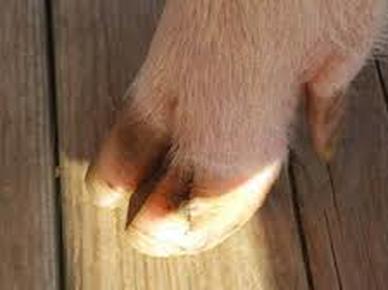
Cloven hoof

This trait was to help protect their hooves from rot while living in moist areas.


As far as pork FOR SALE --

  • We currently have : Bacon, Italian sausage, Breakfast sausage, Bone-in chops and Ham steaks for sale.  Message me for price if interested.
  • We will be sending 3 of the current pigs (2 mulefoots and 1 hampshire) away in the fall.  Their meat will be available for sale then but preorders are preferred.  We do large portion shares, such a 1/2 pig, and piece by piece as well.  Just FYI that large portion shares are flat rate per pound for all cuts and therefore cheaper.
  • We will have piglets for sale from both the Hampshire female and Mulefoot female next spring.  And of course we will continue to sell pork.


Enough selling for now. :)


---------------------------------------------------------------
References:
Blind Taste Test - The Grit
Slow Food USA - Ark of Taste
American Mulefoot Hog Association - Gourmet Meat


Tuesday, November 17, 2015

2015 Pigs Goodbye

Our 3 female pigs (gilts) were sent off last week.  They were BIG this year; the biggest we have had yet.

Here they are once corralled and waiting on the cattle trailer-


The largest weighed in around 375 lbs.  The smaller two weighed around 325 lbs.  We already received our hanging weights (amount they weighed after killed and initial carcass processing) so we are fairly certain of these weights.
That is larger than we want them to get (ideally weight at time of kill should be 275 lbs) because once over 275 lbs the amount of feed they consume to maintain their weight is not economically efficient.  These pigs were 36 WEEKS old.  Usually they are sent off around 28 weeks (I think, my mind is failing me this morning).

Here are the pigs at around 8 weeks old when we got them back in May-


Now 6 months later-

(Just FYI as I say this every year.  No hormones or meds of any kind (other than wormer), pigs just naturally grow fast.  Another FYI, growth hormones are illegal in all US swine production.)

I get asked every year if it is sad to send them off.  I say yes and no.  I believe animals should be respected so we try to treat them as well as possible by allowing them lots of space for foraging and roaming.  Knowing they had a good life makes me not so sad.  As a Christian I feel strongly about treating all of God's creation with respect; since God commanded us to be good stewards.  Now is this type of swine farming possible and/or needed for large markets?  That's another post for another time.  If you feel eating animals is wrong all together I am happy to have a civilized conversation about that as well (and I do respect that viewpoint, we don't eat as much meat as we used to).


Other pig posts that will blow your mind:
The Big Pig Post
How Much Pork In A Pig
Pasture Raised Pork, Is It Worth It?
My personal favorite - Pig Lard vs. The World
Curing Hams


Friday, June 26, 2015

New Coop, First Summer Report

This spring a friend generously gave us his shed he had transformed into a coop.  We were wanting a shed style coop after we had another, we think, weasel attack on our laying pullets which killed one.  Weasels are very hard to keep out since they can squeeze through very small spaces.  The pre-fab sheds are nice because they are solid and easy to secure for the night.


Jonathan made a few alterations such as adding egg doors so the kids could collect the eggs, and a ramp for access to the chicken yard.  Locks and latches we choose were important because some predators can work and open simple devices.


The kids enjoyed the temporary play house.


New pullets seem happy, and it has kept out a lingering raccoon.


We are very thankful Andy's kindness for even transporting the shed to our house. (This is also the friend that drove his tractor across town to turn over our yard for starting our garden 4 years back.)  Thank you Andy!

That garden has been doing ok considering the super dry spring we had. (Planted: tomatoes, white and sweet potatoes, snap peas, beans, leeks, garlic, collards, carrots, beets, lettuce, dill, cucs, radishes, sunflowers, melons and second annual returning pumpkin (came back from last year's pumpkins left)

White and red potatoes are THRIVING this year.  Beets and collards doing pretty good too.  Snap peas as always are doing just so so (New England springs are not the best for snap peas).   Our peas usually don't make it back to the house since the kids eat them first.  I think they like snap peas so much just because they have permission to pick them their self.  Little lady is eating a strawberry.

See what I mean, only one pea made it safely back to the house.  Oh and I forgot about our rhubarb, conveniently ready during strawberry season (rhubarb, strawberry cobbler is one of Jonathan's favorite).

Pigs are growing nicely.  They have nice length in the loins showing the Landrace breed influence (these are Landrace/Hampshire cross breed).  Hams and shoulders are not as rounded as our last Hampshire/Yorkshire crosses but still plenty meat there.


I am continually pleased by the quality stock we get from our piglet farmer (he grows pigs, cows and chickens for meat also and sells to local restaurants, all free range for those curious).

Thats it for now.  As always, construction is in progress on the house.  Dad and Mom T. were here last weekend and helped with some projects.  I hope to share some completed updates with you soon.


Thursday, June 19, 2014

2014 Piglets Are Here!

We got our piglets a recently!  They are only 5 weeks old but already at a strong healthy weight and looking excellent.  We estimate they are somewhere between 20-30 lbs.
Our farmer friend who raises them usually decides when to wean by watching the mother.  He decides to separate them when the mother is looking stressed and tired and when she is becoming irritated and nipping at them (ie, the sow is ready for them to be weaned and is doing it herself).  From my understanding and reading, the sow is usually NOT successful at fully weaning her piglets herself.  Piglets are VERY persistent feeders and their quick growth is evidence of that.  When they are little they are constantly following their mother around waiting for her to lay down so they can nurse.  Once she does they hop right on eat, eat, eat.
Stock photo
Once the piglets get taller they are able to nurse from the mother even when she is not laying down.  Pig farmers will tell you they will pester the mother until she gets pretty irritated at them.... sometimes the mother will even get aggressive with the piglets to ward them off.  Mothers will lay flat on their bellies to keep the tits from the piglets.
Stock photo

A blog post from Sugar Mountain Farm in Vermont explained how they attempted to let the piglets wean naturally, he said they never did and had to intervene due to the mother getting "a bit peaked".

Most farmers wean their piglets between 5-10 weeks from my understanding.  Factory farms wean theirs around 10-15 days.
Piglets start on other sources of food around 4 or weeks..... usually this is feed.  Just like human babies they need more calories eventually than what is found in mother's milk.  Also, sow's milk is devoid of iron.  Therefore piglets being kept on a concrete floor will need an iron supplement.  Piglets with access to dirt will root and get their needed iron from the dirt.
Last, before I share our piglet's photos, I want to mention that I am researching and plan to blog about farrowing crates (stalls where sows are kept while giving birth and through the early days following labor).  Our farmer informed me that they are illegal to use in Massachusetts.  I understand both sides, but I don't think most other people do.  Stay tuned for that if interested.

Now for the our piglet pictures!  Here are our two little gilts (gilt is a female pig before she becomes a mother).


We decided to get only females this year because in the past the females have been cleaner (only using the bathroom in the pasture and not near the food or bedding).  Maybe just a coincidence?  We will see how these do.


Just as previous years, we got Hampshire/Yorkshire crosses.  Long bodies mean more meat capacity.

Cute little hams.

Good hand sniffing form.... back of hand so there's nothing to possibly nip.


Already rooting, look at the little muddy noses-


I think someone else is as happy with these piglets as I am-


She does like animals.  Here is little lady last month at my parents farm.... who doesn't like a good game of peek-a-boo.

Wednesday, February 12, 2014

Curing Hams

We are attempting to cure our own hams this winter.
Mainly for two reasons:

  1. The place we send our pigs to de-bones the hams and smokes them, the hams are usually small and somewhat dry (granted they are not injected with solution like the store hams).
  2. After Jonathan ate my parent's home cured country hams he fell in love.  You can't get anything like that around here that I know of.  Maybe something similar at a specialty store possibly but would be expensive.
So with my parent's counsel we are trying to cure our own.  I hope I wrote down the correct notes over the phone from my Dad.  At the time I was over due pregnant and more brain challenged than usual.

Here is what we did-
We started with one of our FRESH hams.  Not one that talks back, but one that has not been smoked or cured.  The ones at the store are usually smoked or cured to cut down on cooking time.  Our meat processing house gave us one full fresh ham back cut into the two standard pieces: the shank and the butt-

The Butt End is what it implies, the butt or buttocks of the pig.  The Shank is the part below the butt, so more like the pigs back thigh area.
Here is our Butt and Shank (the shank ham already has the rub on it).  They are about 8-10 lbs each.


Here is the recipe my Dad gave me.  I had to search around for Salt Petre (potassium nitrate) but was finally able to get it through the CVS pharmacy for around $5.  Its available online also.

2 cups brown sugar, 1 cup table salt, 3 teaspoon black pepper, 1 teaspoon salt petre-

Rub it on to about 1/8" thickness.  It also exfoliates your hands.

Then we wrapped them in butchers paper.  I was told not to use any waxy type paper so the meat can breath and drip out juices.  Now they just need to cure for around 30-40 days in temperatures between 32-40 degrees Fahrenheit.  The old timers would hang the hams in their smoke house.  We plan to do the same in our shed but temperatures have been really cold here this month.  Right now the hams are curing in our frig.  
If the temperature is below freezing then its not a big deal, the hams just won't cure due to being too cold.  Therefore you would have to allow for more curing days.  If temperature gets above 40 degrees though then the meat could spoil.

Crossing my salty fingers it works!  We will let you know.


Wednesday, November 27, 2013

Farewell 2013 Pigs and Giving Thanks

It was a dark and stormy night as we said farewell to the pig yesterday evening.  I just realized I did not get any pictures of them this past week.  I think the last pictures were from last week.  Anyway....

Piggies at 8 weeks old-

 Pigs around 25 weeks old (sorry I didn't get a better picture of all 4)-

We estimate they weigh around 250lbs each.  So they put on about 200+ lbs in the 17 weeks (4 months) we had them.  250lbs is around the ideal weight you want to be sending them off at.  This is for efficiency reasons.  Maybe I will post more on that later.

Corralling them into the trailer last night was an adventure, in the dark and in the mud.  Thankfully Jonathan was home to help man handle them.  We managed to get the biggest three in without too much stress but the smallest pig slipped out the trailer door before we could get it closed.  Pigs are VERY smart, crazy strong and can be VERY dangerous when panicking.  Once the smallest was separated from the group it panicked and became quite hard to get into the trailer.  Jonathan and our friend did a great job handling the pig and thankfully no people or pigs were hurt in the process.  Might I add that Jonathan did NOT grow up on a farm so kudos to him for learning how to handle these animals and not afraid to muscle the pigs around.  There was alot of contact and muscling that went on.

We are very thankful that all 4 pigs were sent off healthy yesterday.  We're keeping 1 pig's meat for our self and have sold the other 3's meat to friends.  This 'thanks' even made it onto our Giving Thanks Tree-


Baby girl is thankful for simple things as well-

I would like to make Thanksgiving as big of a deal as Christmas in our house.  Taking time to give thanks is super important (you don't have to wait till Christmas to give thanks for our Savior being born)!  I know it is hard to compete with a holiday that brings presents but I believe many things can be done to amplify a holiday.  Kids are easily swayed with cookies and crafts. :)


I am by no means an organized mommy, so doing simple things like crafts and cooking with the kids is NOT a part of my everyday life (some mommies have this skill).  I do my best though.... even if it brings on false labor pains in the act. :)

Hoping everyone has a Happy Thanksgiving and takes time to truly give thanks!