Showing posts with label experiments. Show all posts

Thursday, October 15, 2015

First Annual Apple Butter Day

We did it, we successfully made apple butter the old fashioned way.  Many came, many helped and for that we are soooooo thankful.

A brief note about what apple butter is:
Apple butter is a highly concentrated form of apple sauce (though I hate to put the two in the same sentence).  It is cooked on low (traditionally over a fire) for a very long period of time so that the sugars actually caramelize.  Apple butter was traditionally made to use up the overabundance of apples.  It also preserves longer than apple sauce due to the higher concentration of sugar.  One common confusion is that it does NOT contain any dairy.  I assume the name comes from the consistency because you cook and stir the apples for so long that it becomes thick and almost creamy like butter.  It is different from apple sauce in that it is MUCH more thick and richer in flavor.  Think rich apple jam.  Another important aspect of making traditional apple butter is the community labor.  Due to the length of time of stirring many people share the work, and enjoy the time together while working.
Note that you CAN make apple butter in a crockpot and it is quite delicious.  So far though, the consensus around our house is that the old fashioned way made a much yummier product (good thing).

The rewards-

Starting with 3 bushels of apples.  I used 2 bushels Cortland and 1 bushel Honeycrisp.  The night before we had an apple peeling and coring party.  There was 6 of us and it only took a couple hours.

We started by adding 2 gallons of apple cider and reduced it by half; then we started adding apples in stages as they cooked down.  Beginning stages-

Lots of stirrers on hand and most everyone had a smile on their face while taking their turn-


Time for a thickness test-


Once no water is seeping out of the butter then you start adding sugar and spices-

It should be thick enough to stick to a plate upside down.

Determined-

Beginning canning-

Scraping the pot with biscuits is a treat for the end, and helps clean the pot.


In the end we yielded only 46 pints.  I was anticipating more but it depends on the kind of apples, the amount of water, etc.

Here is the recipe I followed-

  • 2 gallons real apple cider
  • 3 bushels apples (1 bushel = 40lbs apples), any ok cooking apple will do
  • Sugar (I used 16 lbs white, 2 lbs brown.  Add to taste depending on your apples)
  • 1/2 cup cinnamon, or to taste
  • 2 ozs cloves, or to taste
We ended up not getting 1/2 bushel of apples into the butter due to concern of time.  So the 2.5 bushels yielded 5.75 gallons or 46 pints of apple butter as I said above.  The recipe estimated yielding 12 gallons butter, so as you can see different apples cook down differently.

Time and stirring
We started the cider around 8am and started adding apples around 9am.  We began canning around 5:30 pm, I think.  So thats 8.5 hours of cooking/stirring.  You MUST stir constantly as I have been warned it will ruin the whole pot if any hot spots are formed since the apples will stick and burn.

Last, cleaning the pot.  We used an antique brass kettle and wanted to make sure we cleaned it properly. (Note that when cooking with apples be sure to use a non reactive pot).  First, wash out excess sauce with soap and warm water.  Second, scour the pot with warm ashes (this really worked well).  Third, wash the pot with soap and warm water again and rinse clean.  Dry it completely.  Oil the paddle and store everything in anticipation of doing again next year.

Conclusion, the work was most definitely worth it.  Now eat the apple butter on warm buttery toast with a side of bacon.... for dinner.... like we did last night.

P.S. there are many other uses for apple butter in recipes, look them up. :)


Wednesday, May 20, 2015

Eat More Weeds

I have reached Level 5 of Domesticism.  I can't quite place a symbol figure for this level but Level 8 would be Ruby, from the book/movie Cold Mountain:

Level 9 would be Christy.


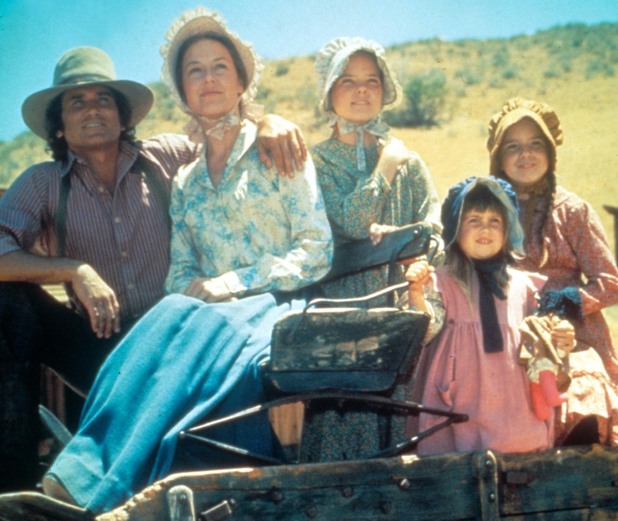
And Level 10 would be Caroline Ingalls (from Little House On The Prairie):

But I figure if I were to reach these upper levels I would have to be without electricity or internet so you would not hear of my rise in skill sets.  So if I drop off the grid you can secretly cheer for me and  and think of me hunting out road kill and eating dandelions.

So back to eating weeds.  I truly am promoting it (only if you properly educate yourself first, oh and promoting only the legal ones too).
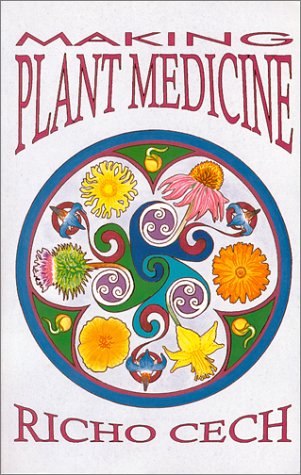
This past Christmas Jonathan fueled my strange hobby endeavor by getting me this book:

I have found herbology to be pretty interesting.  No, I don't wear tie dye and ankle skirts (though there is nothing wrong with that), but I like history and I like plants... and I like self sufficiency so herbology is a good study for me.
Don't worry, I am not turning on modern medicine.  And I am not making any crazy and possibly dangerous tinctures, I don't plan to go that far.  But I did pick some wild violets in our yard this spring and seeped them in oil to make a soothing skin oil.  If you think that is weird then look at the ingredients in your lotion, does it contain aloe, then you rubbed the guts of a plant on your skin too.


Other medicinal herbs/plants/weeds you are probably consuming include rosemary (digestion, circulation), thyme (antiseptic, good to treats colds), garlic (digestion, circulation and more), oregano (antioxidant, antiseptic) and oats (soothing).... just to name a common few.  Herb's medicinal compounds are extracted and used everywhere.  One for example is thymol, a compound extracted from common thyme, is used in mouthwashes such as Listerine (source).  I could also say something about mint, licorice and marshmallow, all once sweetened and used medicinally.... now just an artificial flavor added to corn syrup for a candy.

So back to weeds, these are medicinal plants I discovered growing in our yard:

(All the medicinal notes are summarized from Making Plant Medicine book, as mentioned above, by Richo Cech.  I am NOT a doctor nor do I claim to be, so therefore don't take my word for these things.  I encourage you to research this stuff on your own if interested in personal use.)

Cleavers:
These guys were found growing near our water facet, guess they are moochers of the drippage.
Cleansing of the lymphatic and urinary tract system and blood.  A strong diuretic used helping with urinary tract problems (such as kidney stones).  I picked some, dried it (on an awesome homemade Christmas present from my sister-in-law) and made my husband drink it in some tea.  He lived.... and had to pee a lot, so I guess it worked.

Drying

Lady's Mantle:
This lovely flowering plant was already planted in a flower bed next to the old koi pond.
Appropriately named, good for general women's health.  Books says helpful in toning reproduction organs, good pregnancy tonic, postpartum relief, mood swings and other womanly problems (cause y'all know we gots the problems) .  Apparently a popular tea still for women in other countries.


Echinacea:
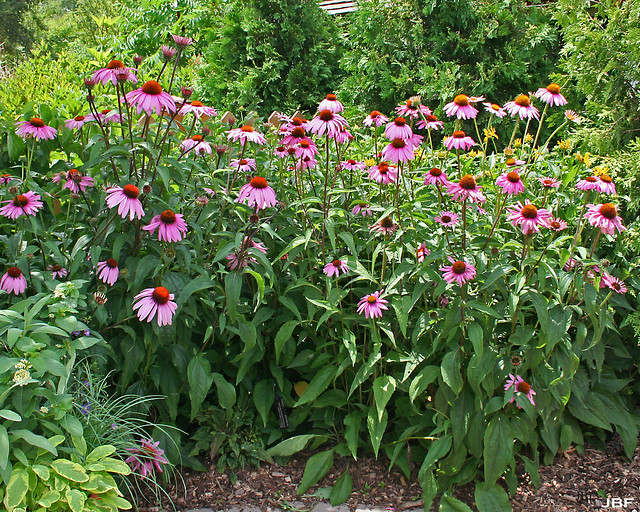
An immune stimulant that increases overall disease resistant.  This tea actually taste pretty good (I buy the tea instead of making it myself).


Violets:
We have violets growing all though out our yard.  I know its not lush grass but it gives a nice color in the spring.
Cooling and healing, for either internal or external issues; upper repository infections to skin problems.  This is what I made my skin oil from, as mentioned above.


Stinging Nettle:
This guy hangs out in our asparagus patch.  
Nettle is a nutritive tonic, apparently high in chlorophyll, potassium and calcium.  The fresh herb can be used for making beer.


Chick Weed:
This guy pops up everywhere there isn't grass I feel like.
Increases energy levels and fat metabolism.  An excellent hen feed, increasing eggs size and production and even the nutritional value of the egg.  Guess thats the reason it takes over flower beds and gardens even when thought it was properly weeded the season before.... because it needs to pulled up and eaten by a human or a hen.


Burdock:
This big ugly monster is not welcome in our yard, but he is persistent.  The spiny burrs freak little lady out every time she discovers them attached to her, thinking its a spider.  So on top of medicinal properties it is helping her over come some fears.
Used in treating staph infections, impetigo and other ulcerations.  Combined with dandelion or yellow dock could be used to treat psoriasis, eczema, oily skin, boils and gout.
Plant in spring
Burs later in season
That is all I discovered for now.  To answer your question, no, I am not out grazing on all fours on the weeds throughout our yard.  And don't worry the kids and I don't try anything without testing it on Jonathan first.  So far he is doing fine. ;)


Wednesday, February 12, 2014

Curing Hams

We are attempting to cure our own hams this winter.
Mainly for two reasons:

  1. The place we send our pigs to de-bones the hams and smokes them, the hams are usually small and somewhat dry (granted they are not injected with solution like the store hams).
  2. After Jonathan ate my parent's home cured country hams he fell in love.  You can't get anything like that around here that I know of.  Maybe something similar at a specialty store possibly but would be expensive.
So with my parent's counsel we are trying to cure our own.  I hope I wrote down the correct notes over the phone from my Dad.  At the time I was over due pregnant and more brain challenged than usual.

Here is what we did-
We started with one of our FRESH hams.  Not one that talks back, but one that has not been smoked or cured.  The ones at the store are usually smoked or cured to cut down on cooking time.  Our meat processing house gave us one full fresh ham back cut into the two standard pieces: the shank and the butt-

The Butt End is what it implies, the butt or buttocks of the pig.  The Shank is the part below the butt, so more like the pigs back thigh area.
Here is our Butt and Shank (the shank ham already has the rub on it).  They are about 8-10 lbs each.


Here is the recipe my Dad gave me.  I had to search around for Salt Petre (potassium nitrate) but was finally able to get it through the CVS pharmacy for around $5.  Its available online also.

2 cups brown sugar, 1 cup table salt, 3 teaspoon black pepper, 1 teaspoon salt petre-

Rub it on to about 1/8" thickness.  It also exfoliates your hands.

Then we wrapped them in butchers paper.  I was told not to use any waxy type paper so the meat can breath and drip out juices.  Now they just need to cure for around 30-40 days in temperatures between 32-40 degrees Fahrenheit.  The old timers would hang the hams in their smoke house.  We plan to do the same in our shed but temperatures have been really cold here this month.  Right now the hams are curing in our frig.  
If the temperature is below freezing then its not a big deal, the hams just won't cure due to being too cold.  Therefore you would have to allow for more curing days.  If temperature gets above 40 degrees though then the meat could spoil.

Crossing my salty fingers it works!  We will let you know.


Wednesday, October 30, 2013

Pig Lard vs. The World

Poor, poor lard.  For the past 50ish years its reputation has been smeared by MASSIVE misconceptions.  But it seems that it might be getting its well deserved come back.  If you are gasping at what I am saying, PLEASE continue reading my friends.

Depending on what generation you are from I know its hard to know who to believe when it comes to nutrition.  I mean, the 'expert's' opinions seems to keep changing, right?  Kind of but not really.....


First, what is lard 
Lard is the fat from a pig.  For cooking purposes it is rendered and solidifies into a form similar to shortening.  Lard typically is rendered from the back area (known as fat back) or the visceral fat from around the kidney/loin area (known as leaf lard).  Leaf lard is most likely what your grandmother or great grandmother used to make all her biscuits and pie crusts.  Its not hard to find an online forum where cooks are still saying that leaf lard is a superior product to making such (over butter AND shortening).  Leaf lard is more neutral in flavor than fat back lard.  Fat back lard is used more for frying purposes.


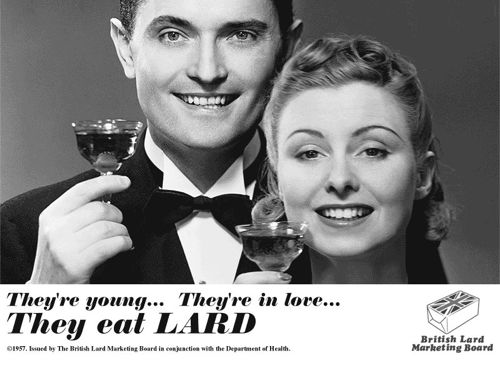
I am curious to know what role lard played in making this couple young and in love.

The Skinny On Fat

As you know, our bodies have to have fat (whether from an animal or a plant source).  Our brain, and hormones rely on fat to function.  Fat also helps the body to absorb nutrients, calcium, and the fat-soluble vitamins A, D, E, and K.  It is said that if you’re drinking non-fat milk enriched with vitamin D, your body will have a difficult time absorbing both the vitamin and the calcium since it lacks saturated fat to help the body do so.  This is just the surface of it, please read a smarter person's explanation HERE (in the introduction).

So fat is a must and very important, but here is the thing-

Not All Fats/Oils Are Created Equal

We can all agree that some fats are bad and some are good.  Research still continues to work on a 'cut dry' answer on this.  Let's back up in history for just a moment to get back to lard-
Animal fats started to get their bad rap in the 1950's when a study was published linking saturated fats with heart disease.  It was a faulty study but the vegetable oil industry greatly benefited from it. 
Not an actual ad, its an album cover.
People have since taken a second look since the general public's cardiovascular health does not seem to be improving.
Lard vs. Crisco and Margarine
One thing research of fats has agreed on across the board is that what replaced these animal fats (such as Crisco and margarine) are much more dangerous to our health.  This is because of the trans fat content (all agree trans fat is a bad guy, read more here if interested).  I know that in recent years they have developed margarine and shortening with less to no trans fat, but back when it replaced lard this was NOT the case.  According to this Harvard Health article, there was NEVER any solid evidence that using margarine over butter lowered your chance of developing heart disease.  Back to Lard, it contains little to NO trans fats.  Lard that has been heavily processed to give it longer shelf life might have small traces of trans fat, but from my research home rendered or lightly processed lard most likely will have even smaller traces (and even smaller traces if pasture raised).  Shortening (Crisco) which is now made, so called, 'trans fat free' most certainly still has trans fat.  If any product lists a partially hydrogenated oil in its ingredients (which Crisco does along with most margarines I believe) then it DOES contain trans fat.  It is able to claim trans fat free because the FDA allows products containing less than 0.5g in a serving size as trans fat free. (says so here).  The serving size for Crisco is 1 Tablespoon. I don't know about you but none of my recipes requiring shortening call for as little as 1 Tablespoon.  My grandma's biscuits recipe for instance uses up to 1/2 cup shortening, those trans fat grams add up.
Soooo, in regards to trans fat, lard easily wins the healthier prize-
Lard - 1,  Shortening and most margarines - 0

Lard vs. Butter

Let me start out by saying that I would rather spread delicious butter on my toast than lard (though some countries do use lard as a spread).  Put similar applications aside.... the argument here is centered around saturated fat.  Saturated fat from animal and plant sources provide a concentrated source of energy, provide building blocks for cell membranes and are needed for hormone production (just to name a few pros).  From my understanding though, this particular fat is the center of the most controversy: some believing it is a bad fat connected to heart disease, others believe it should be consumed regularly and quite essential to your health.  I will share that I believe if you are overall a healthy person I agree with the saturated fat advocates.  A few good sources supporting this found here and here (see Saturated Fat section).  I encourage you to research and decide for yourself.
As you know, all things have to be consumed in moderation, even good fats.  The major health sites recommend limiting dietary fat to no more than 20-35% of your daily calorie intake (per mayoclinic's article here).  So here is my quick undercut to butter (sorry dear, delicious friend).  Per tablespoon lard has 16% less saturated fat than butter (7g vs 5g).  Ramp that serving size up to 1 cups worth (needed for most pie crust recipes), lard has 37 less grams of saturated fat than butter.  Here's another quick punch- lard has double the monounsaturated fat (a very good fat for your health, agreed across the board) than butter.  Lard having 6g per tablespoon vs. butter's 3g (Crisco has 2.5g/tablespoon).
So in regards to healthy fat ratio and content-
Lard - 1, Butter - 0


Lard vs Olive Oil

Oh yes I did, I am totally going here.  It is well established that olive oil is a superior oil to consume for your health.  It is very high in that good fat we just talked about (monounsaturated fat) with 10g in 1 tablespoon.  It is also trans fat free in its natural state and low in saturated fat.  One concern some have with extra virgin olive oil is that when it is heated to its smoking point, it becomes unstable and changes in composition.  Some of it's health benefits are lost and it also forms trans fat when over heated.  Makes sense since this why over processed vegetable oil products have trans fat (such as shortening and margarine, ie trans fat is mostly man made from over processing).  Lard can only kick olive oil in the shin at this fight as its smoking point it not too much higher than regular olive oil.  (And I read that unless you are heavily deep frying in olive oil you are most likely NOT reaching its smoking point).  Lard IS more stable and has a longer shelf life than olive oil, therefore holding its nutritional value longer.  But one area that lard is way more nutritious than olive oil is the Vitamin D department.  Olive Oil has ZERO grams of vitamin D vs. pastured lard having up to 1000 IU of vitamin D per tablespoon.  This source is second to only cod liver oil... and again remember it has to be from pastured pigs (where pigs are foraging and getting their sunlight). According to the US Institute for Medicine, it is recommended for children and adults to receive 600 IU per day.  Vitamin D is super important to our health so I will still consider this victory over olive like a small slap in the face (sorry this post is so violent).
So in regards to the important vitamin D-
Lard - 1, Olive Oil- 0

"That'll do pig, that'll do".

Finally in conclusion, maybe you should look into the fats you are consuming.  Don't make your judgements until you do so.  And don't judge something until you do (like pork lard).  Also remember that store lard is NOT the same product usually, most likely containing the partially-hydrogenated fats as discussed before from the processing.
If you are one of those people who research which oil is best to put in your car for better performance (I did this back in my day of cool car ownership) or which conditioner makes you hair the most healthy (I did this too back when I had time to wash my hair).... THEN WHY IN THE WORLD NOT CARE WHAT FATS (or all foods in general) YOU PUT INSIDE YOUR BODY.  I think you will benefit much more with a healthy feeling body.  Sorry for the yelling, the kids were quite uncooperative this morning (yes, thats my excuse).

To end here are some pictures of my home rendered lard (from our pigs) and some products made from it-

Cut up leaf lard and rendered slowly in the crock pot-

Finished, cooled product-


Happy customer, most definitely makes biscuits fluffier than shortening (I recommend leaf lard and its mild flavor for this and pie crusts)-

I cannot take credit for this berry pie, our friend Topper made it.  I asked him to make one while visiting once since he makes one of the BEST pie crusts I have ever had!

Thursday, August 15, 2013

Quinoa Growing Experiment and Fall Garden

This year we are trying to grow quinoa.  Since quinoa apparently does NOT like temperatures above 90F degrees I thought I would try it as a late summer crop (because we had multiple days over 90 degrees in July this year).  Its growing time is between 90-120 days so we are hoping for a possible October harvest.  They can handle light frost especially if the seed (the part that you harvest and eat from the plant head) is past the green stage.

The plants are tall and quite lovely.  You can even eat their VERY nutritious leaves at young growth.

Quinoa is extremely popular because of the seed nutritional content, mainly the protein content is what interests people.

Quinoa is mostly grown in the Andean highlands of Bolivia and Peru but its recent popularity has inspired some regions in North America to try experimentation crops.  This popularity has also brought up controversy due to the rise of price thats been inflicted on the original growing regions.  Reports say those areas, which used quinoa as a dietary staple, can no longer afford it for themselves.
I am not an expert in this area and can't express an opinion one way or the other.  We thought we would try to grow it for economical reasons.  Currently, the cost is about $8/lb at my grocery store and not always available.  A packet of seeds is around $2.00 (which has enough seeds for 6+ pounds worth of harvest).

Anyway, I planted enough plants to harvest about 1 pound worth of seed.  If it works out we will try more next year and maybe even sell it.  Currently though, I am having trouble with getting it to germinate.  I will keep you updated as things progress, if they progress.

Along with quinoa I have planted our 'late summer' garden or short season and cool season plants.  We recently harvested beets and potatoes from this area.


In harvesting news, we are giving thanks for a good season so far.
Amish Paste tomatoes in the basket, Brandywine heirloom tomato still ripening on the vine-

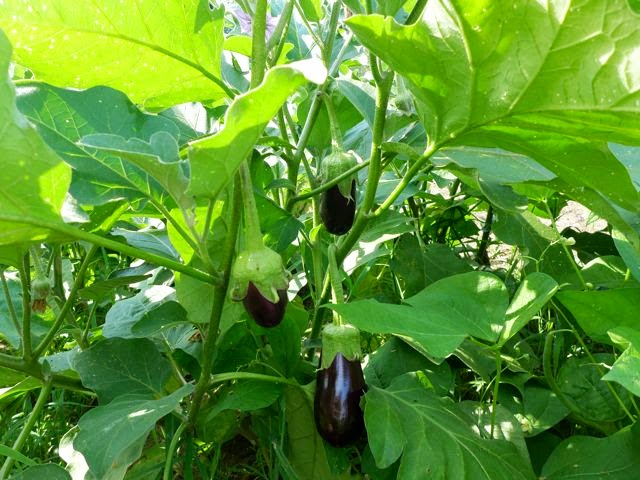
Lots of eggplants still growing-


First year of trying soybeans (for edamame) going well so far-

We had a good harvest from the blue potato plant the came back from last year.  As roasted, these potatoes are not as tasty as some other varieties.  They are more for potato salads I would say... but interesting to look at with their blue flesh.


I am itching to get a house update post on here soon.  Hopefully that will happen. :)