Showing posts with label home grown meals. Show all posts

Thursday, August 25, 2016

Sorry Ducks

Summer time is filled with lots of activity and work, that is for sure.  I think the busyness of all the to-dos help me cope with the coming of fall (less gardening, food preserving, yard work, etc).  Though apple butter season will be approaching soon, Eek!!

We recently put another homesteading tool in our belt; that tool being the experience of killing and cleaning our own ducks.  In poor meat fowl raising fashion, I lost track of how old the ducks were and we didn't know their live weight.  I suppose if the ducks were self consciousness about their weight and age like us silly humans at least they 'went out' with no complexes.
https://www.threadless.com/designs/duck-face-4

Any who, we heard from different people that cleaning ducks was a tedious task with the amount and type of feathers.  This we now understand.  From our homesteading books we read that you attempt to kill them during their second molt, which reduces some of the plucking.  We think we got them before their full second molt but had to schedule the killing instead to coordinate with summer travel plans.  After killing them we realized based on their dressed weight they should have been larger.  But I digress.
(Dressed weight typically means the weight after the animal is killed and internal organs and less desirable portions of the animal removed.  Not this-)

Moving on....

PLEASE NOTE: I refrained from showing graphic pictures for those that are sensitive to such.  The most graphic picture is Jonathan holding a headless duck, no blood is visible.  Just want to point that out but encourage everyone to look at the process.

(Up until kill day, kid stalking was probably the most stressful thing our ducks encountered)-

Fact: If you eat animals death is involved.  I think that is important to embrace for the sake of perspective and respect.  I personally feel as a Christian that we are to be good care takers of God's creation and not just say 'ignorance is bliss' in regards to animal processing.  I don't think animals are here for our careless expenditure (careless being key word).  I know I am opening up a can of worms here, maybe more on this another time.  The fact is lots of animals die daily to keep up with our country's food demands.  Just a quick Google search told me that roughly 21 million chickens are EATEN DAILY in the US alone.  Whoa nelly!  A lot of deaths.

I like knowing that our animals have one bad day in their lives; kill day.  The same can be true for large livestock operations as well, but I believe it is not always the case.  I also like that our killing is instant.  We chop the head off in one quick blow with an axe.  In large poultry operations birds are hung upside down, stunned (I think usually electrically) to remove feeling, then their throats are cut to bleed out.  This process has a reason to it and I understand that.  There are also laws (or guidelines, not clear on this yet) to ensure the process is quick and not drawn out to make it as humane as possible.  I am sharing this information for comparison and again for perspective sake.

Here is a link that I found helpful if you want to know more about poultry processing.

Onto our duck processing.

Step 1 Killing the animal.  We did this by me holding the duck in my hands (and I actually got sad and considered not killing it at this point), Jonathan laying its head on a tree stump with one hand and cutting the head off with ONE swift blow with his axe.  There was little to no struggle.  At this point the animal bleeds out.


Step 2 We dipped the duck in boiling water to help with the plucking process.  For the most part feathers came out easily and quickly (we followed water temperature and scalding time recommendations) but the pin feathers were a beast to remove.

-Plucked and wing ends removed.

Step 3  Next you need to remove all the innards.  You do this by cutting around the duck's anus using great care to not nick the digestive tract (which could release feces and get on the meat which is not ideal).  Once you cut that part free from the body then the innards can start being pulled out.  Once the duck is completely cleaned out we did another rinse inside and outside for good cleanliness practice.
No picture for this step, our hands were really dirty and we wanted to move them as quickly as possible to be chilled.

Step 4 Now the carcasses have to chill to an internal temperature of 40F.  Chillin'-

Step 5  Once chilled we vacuum sealed them and put them in the freezer.  Done.

Step 6 Cook and eat them, which is going to happen tonight.

Duck fat is a healthy fat (in my pro fat opinion) and duck meat is rich in flavor.  Some people describe it as tasting like all dark and very juicy meat.

That is all I can write for now; sorry to end so abruptly, motherhood is calling. :)


Wednesday, July 22, 2015

Just A Shellin'

If our garden was a party scene with the plants as the partiers, our peas would be SHUTTING DOWN THE SPRING PARTY SCENE (meaning they did their thing well and now it's time to say goodbye).  They stayed later than usual but provided us with plenty to do a 'cabbage patch dance' about. <insert mental image>

I planted sugar snap peas and also transplanted some mystery variety that the kids brought home from a story time craft project at the library (yes, a library craft project provided us with food).  We also have 3 nice sunflowers going strong that was brought home from the same event.

I had help picking but my partners were surprised to find out their duties didn't end there.  Time to shell and it's SOOOO FUN!


My smallest partner observed....
Bracelet is a thumb weaning contraption (Dr. Thumb)

And observed....

But only offered us a few sounds of encouragement, at least we think they were of encouragement.

To be honest, little man enjoys work like this just as long as socializing is involved (sounds like me), the other doesn't like to be hot.... but I foresee her being a good cook of these home grown meals one day (little lady likes to watch and help me cook).
Cute grubby hands staying busy-


The shelling was completed, pea plants have left the party (aka our garden), and now more 'floor' is available for our sweet potato vines to shimmy on into.

Time to do the sprinkler.


Wednesday, May 7, 2014

New Hens and First Big Planting

Say hello to the newest additions of our farm family....  Red 1, 2 and 3-


Post of what happened to our previous hens HERE.

Three young Rhode Island Reds given to us by a friend.  No names yet because they look so similar.

Somewhat sociable, as much as our last hens I guess.

I did love our heirloom hens that laid colored eggs, but they were not the best layers.  These ladies are very hardy and should lay everyday throughout most of the year.  Not as glamourous but very efficient.
Happy to have fresh eggs in the frig again.


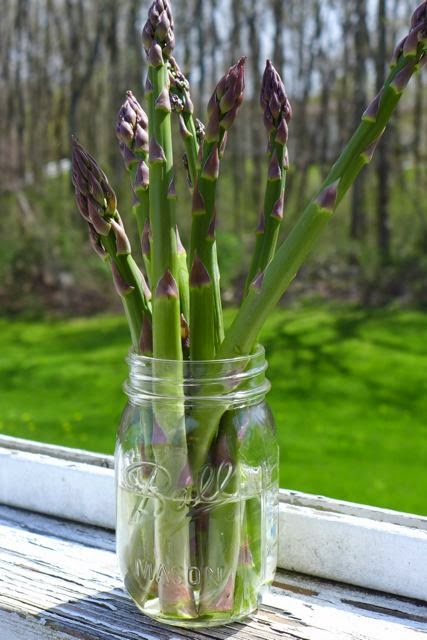
You know what soft eggs and/or over easy eggs go well with.....  Asparagus!
We add some cream sauce too (sometimes with a bit of dijon mustard).  Plenty recipes on the web and I encourage you to give it a try if you have not.
Photo courtesy of Poorgirleatswell.com
Please share your favorite asparagus recipes.  This is another new vegetable for me to use regularly.  I made chicken, asparagus and bell pepper stir fry just tonight.  Kids ate it up.

We are getting lots of strong shoots.  I have made about 3 side dishes worth.


Along with our asparagus shooting up daily (though we are reframing from picking too many since they are young plants building strength) we worked up a section of our garden this past weekend.  We had the garden covered with a clear plastic sheet/tarp (from Lowes) for about a month to help heat the soil and keep it dry.  It worked.  Soil under the plastic was ready to work unlike the soil that was not covered.  Also, our cover crop of winter rye was thicker and taller on the side that was covered, because the soil was warmer (yes, it grew just fine under the plastic laying directly on top of it).  Why a cover crop post HERE.

As you probably know, DO NOT TURN OVER WET SOIL.  Reason why HERE.
Ideally you should turn it over, let it set about a week to allow weeds to rot, add organic matter/fertilizer, then turn it over again before you plant.  We planted immediately after turning it over which will result in us having to pull more weeds in the near future.

The strong man behind the tiller said the soil was much looser and easier to turn over than previous years.


This is what we got planted (still just cool weather plants):
  • More leaf lettuce
  • Radishes (not a fan but giving home grown ones a chance)
  • Carrots
  • Red potatoes
  • Sugar snap peas
  • Beets
  • Garlic (yeah, behind again this year by missing out on planting them in the fall.  hopefully it will still work)


Planting sugar snap peas.  He planted an entire 20' row himself with the help of a 'spacing stick'.


Hope to see some plants popping up anytime now.


Wednesday, February 12, 2014

Curing Hams

We are attempting to cure our own hams this winter.
Mainly for two reasons:

  1. The place we send our pigs to de-bones the hams and smokes them, the hams are usually small and somewhat dry (granted they are not injected with solution like the store hams).
  2. After Jonathan ate my parent's home cured country hams he fell in love.  You can't get anything like that around here that I know of.  Maybe something similar at a specialty store possibly but would be expensive.
So with my parent's counsel we are trying to cure our own.  I hope I wrote down the correct notes over the phone from my Dad.  At the time I was over due pregnant and more brain challenged than usual.

Here is what we did-
We started with one of our FRESH hams.  Not one that talks back, but one that has not been smoked or cured.  The ones at the store are usually smoked or cured to cut down on cooking time.  Our meat processing house gave us one full fresh ham back cut into the two standard pieces: the shank and the butt-

The Butt End is what it implies, the butt or buttocks of the pig.  The Shank is the part below the butt, so more like the pigs back thigh area.
Here is our Butt and Shank (the shank ham already has the rub on it).  They are about 8-10 lbs each.


Here is the recipe my Dad gave me.  I had to search around for Salt Petre (potassium nitrate) but was finally able to get it through the CVS pharmacy for around $5.  Its available online also.

2 cups brown sugar, 1 cup table salt, 3 teaspoon black pepper, 1 teaspoon salt petre-

Rub it on to about 1/8" thickness.  It also exfoliates your hands.

Then we wrapped them in butchers paper.  I was told not to use any waxy type paper so the meat can breath and drip out juices.  Now they just need to cure for around 30-40 days in temperatures between 32-40 degrees Fahrenheit.  The old timers would hang the hams in their smoke house.  We plan to do the same in our shed but temperatures have been really cold here this month.  Right now the hams are curing in our frig.  
If the temperature is below freezing then its not a big deal, the hams just won't cure due to being too cold.  Therefore you would have to allow for more curing days.  If temperature gets above 40 degrees though then the meat could spoil.

Crossing my salty fingers it works!  We will let you know.


Wednesday, October 30, 2013

Pig Lard vs. The World

Poor, poor lard.  For the past 50ish years its reputation has been smeared by MASSIVE misconceptions.  But it seems that it might be getting its well deserved come back.  If you are gasping at what I am saying, PLEASE continue reading my friends.

Depending on what generation you are from I know its hard to know who to believe when it comes to nutrition.  I mean, the 'expert's' opinions seems to keep changing, right?  Kind of but not really.....


First, what is lard 
Lard is the fat from a pig.  For cooking purposes it is rendered and solidifies into a form similar to shortening.  Lard typically is rendered from the back area (known as fat back) or the visceral fat from around the kidney/loin area (known as leaf lard).  Leaf lard is most likely what your grandmother or great grandmother used to make all her biscuits and pie crusts.  Its not hard to find an online forum where cooks are still saying that leaf lard is a superior product to making such (over butter AND shortening).  Leaf lard is more neutral in flavor than fat back lard.  Fat back lard is used more for frying purposes.


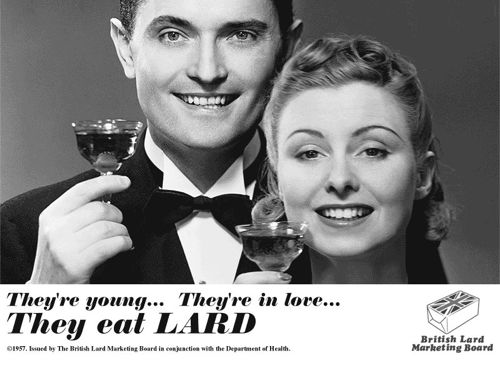
I am curious to know what role lard played in making this couple young and in love.

The Skinny On Fat

As you know, our bodies have to have fat (whether from an animal or a plant source).  Our brain, and hormones rely on fat to function.  Fat also helps the body to absorb nutrients, calcium, and the fat-soluble vitamins A, D, E, and K.  It is said that if you’re drinking non-fat milk enriched with vitamin D, your body will have a difficult time absorbing both the vitamin and the calcium since it lacks saturated fat to help the body do so.  This is just the surface of it, please read a smarter person's explanation HERE (in the introduction).

So fat is a must and very important, but here is the thing-

Not All Fats/Oils Are Created Equal

We can all agree that some fats are bad and some are good.  Research still continues to work on a 'cut dry' answer on this.  Let's back up in history for just a moment to get back to lard-
Animal fats started to get their bad rap in the 1950's when a study was published linking saturated fats with heart disease.  It was a faulty study but the vegetable oil industry greatly benefited from it. 
Not an actual ad, its an album cover.
People have since taken a second look since the general public's cardiovascular health does not seem to be improving.
Lard vs. Crisco and Margarine
One thing research of fats has agreed on across the board is that what replaced these animal fats (such as Crisco and margarine) are much more dangerous to our health.  This is because of the trans fat content (all agree trans fat is a bad guy, read more here if interested).  I know that in recent years they have developed margarine and shortening with less to no trans fat, but back when it replaced lard this was NOT the case.  According to this Harvard Health article, there was NEVER any solid evidence that using margarine over butter lowered your chance of developing heart disease.  Back to Lard, it contains little to NO trans fats.  Lard that has been heavily processed to give it longer shelf life might have small traces of trans fat, but from my research home rendered or lightly processed lard most likely will have even smaller traces (and even smaller traces if pasture raised).  Shortening (Crisco) which is now made, so called, 'trans fat free' most certainly still has trans fat.  If any product lists a partially hydrogenated oil in its ingredients (which Crisco does along with most margarines I believe) then it DOES contain trans fat.  It is able to claim trans fat free because the FDA allows products containing less than 0.5g in a serving size as trans fat free. (says so here).  The serving size for Crisco is 1 Tablespoon. I don't know about you but none of my recipes requiring shortening call for as little as 1 Tablespoon.  My grandma's biscuits recipe for instance uses up to 1/2 cup shortening, those trans fat grams add up.
Soooo, in regards to trans fat, lard easily wins the healthier prize-
Lard - 1,  Shortening and most margarines - 0

Lard vs. Butter

Let me start out by saying that I would rather spread delicious butter on my toast than lard (though some countries do use lard as a spread).  Put similar applications aside.... the argument here is centered around saturated fat.  Saturated fat from animal and plant sources provide a concentrated source of energy, provide building blocks for cell membranes and are needed for hormone production (just to name a few pros).  From my understanding though, this particular fat is the center of the most controversy: some believing it is a bad fat connected to heart disease, others believe it should be consumed regularly and quite essential to your health.  I will share that I believe if you are overall a healthy person I agree with the saturated fat advocates.  A few good sources supporting this found here and here (see Saturated Fat section).  I encourage you to research and decide for yourself.
As you know, all things have to be consumed in moderation, even good fats.  The major health sites recommend limiting dietary fat to no more than 20-35% of your daily calorie intake (per mayoclinic's article here).  So here is my quick undercut to butter (sorry dear, delicious friend).  Per tablespoon lard has 16% less saturated fat than butter (7g vs 5g).  Ramp that serving size up to 1 cups worth (needed for most pie crust recipes), lard has 37 less grams of saturated fat than butter.  Here's another quick punch- lard has double the monounsaturated fat (a very good fat for your health, agreed across the board) than butter.  Lard having 6g per tablespoon vs. butter's 3g (Crisco has 2.5g/tablespoon).
So in regards to healthy fat ratio and content-
Lard - 1, Butter - 0


Lard vs Olive Oil

Oh yes I did, I am totally going here.  It is well established that olive oil is a superior oil to consume for your health.  It is very high in that good fat we just talked about (monounsaturated fat) with 10g in 1 tablespoon.  It is also trans fat free in its natural state and low in saturated fat.  One concern some have with extra virgin olive oil is that when it is heated to its smoking point, it becomes unstable and changes in composition.  Some of it's health benefits are lost and it also forms trans fat when over heated.  Makes sense since this why over processed vegetable oil products have trans fat (such as shortening and margarine, ie trans fat is mostly man made from over processing).  Lard can only kick olive oil in the shin at this fight as its smoking point it not too much higher than regular olive oil.  (And I read that unless you are heavily deep frying in olive oil you are most likely NOT reaching its smoking point).  Lard IS more stable and has a longer shelf life than olive oil, therefore holding its nutritional value longer.  But one area that lard is way more nutritious than olive oil is the Vitamin D department.  Olive Oil has ZERO grams of vitamin D vs. pastured lard having up to 1000 IU of vitamin D per tablespoon.  This source is second to only cod liver oil... and again remember it has to be from pastured pigs (where pigs are foraging and getting their sunlight). According to the US Institute for Medicine, it is recommended for children and adults to receive 600 IU per day.  Vitamin D is super important to our health so I will still consider this victory over olive like a small slap in the face (sorry this post is so violent).
So in regards to the important vitamin D-
Lard - 1, Olive Oil- 0

"That'll do pig, that'll do".

Finally in conclusion, maybe you should look into the fats you are consuming.  Don't make your judgements until you do so.  And don't judge something until you do (like pork lard).  Also remember that store lard is NOT the same product usually, most likely containing the partially-hydrogenated fats as discussed before from the processing.
If you are one of those people who research which oil is best to put in your car for better performance (I did this back in my day of cool car ownership) or which conditioner makes you hair the most healthy (I did this too back when I had time to wash my hair).... THEN WHY IN THE WORLD NOT CARE WHAT FATS (or all foods in general) YOU PUT INSIDE YOUR BODY.  I think you will benefit much more with a healthy feeling body.  Sorry for the yelling, the kids were quite uncooperative this morning (yes, thats my excuse).

To end here are some pictures of my home rendered lard (from our pigs) and some products made from it-

Cut up leaf lard and rendered slowly in the crock pot-

Finished, cooled product-


Happy customer, most definitely makes biscuits fluffier than shortening (I recommend leaf lard and its mild flavor for this and pie crusts)-

I cannot take credit for this berry pie, our friend Topper made it.  I asked him to make one while visiting once since he makes one of the BEST pie crusts I have ever had!

Wednesday, September 11, 2013

Don't Be An Eggplant Hater

Don't be a hater, they are pretty nice, versatile little vegetables.
Yes I put googly eyes on vegetables....

Who needs Mr. Potato Head...


The above eggplant is obviously a mutant, eggplants are quite lovely looking vegetables-


Though they are a part of the shady nightshade vegetable family (but so are tomatoes and potatoes),  their health benefits are abundant, most notably the antioxidant content in the skin and dietary fiber content.

I admit, I did not eat eggplant myself before I was married.  My husband influenced me to cook with it because he loved eggplant parmesan.  His love for this dish led to us growing it ourselves and then I had no choice but learn to do other things with it.  True and gripping story, I know.


This year has been a good year for eggplant to say the least.  So far we have harvested around 63 eggplants.  I have kept up with the poundage as well so we can compare what that would equal if we would have bought that amount.  (Spoiler alert: I have kept the poundage amounts of everything we have harvested to see how much money growing your own food can save you, blog post about that sometime this fall).

Here is what I have done with the eggplants-
  • Roasted with pasta
  • Sliced thin, rolled and stuffed with ricotta (good substitution for pasta)
  • Grilled with herbs, as a side dish
  • Baba ghanoush (roasted eggplant dip, froze many small containers for wraps and such)
  • Moussaka (like a greek lasagna, I was surprised that I liked this.  everyone else did as well)
  • Eggplant Parmesan
  • Roasted with other veggies in balsamic vinegar for wraps (good with hummus)
  • Stacks (including tomato, portobello mushroom caps, mozzarella cheese and herb oil)
  • Vegetable Lasagna (like regular lasagna with some extra veggies layered in.  my friend Stephanie generously made us one using our eggplant, it was REALLY good)
  • Ratatouille (not just a movie, an amazingly delicious French Provencal vegetable stew)

Still planning to try (because there are a ton left in the garden):
  • Other varieties of Vegetable Lasagna (freezes well)
  • Chop and freeze (as a filler for vegetable soups, stews and chilli.  heard this works well)
  • Eggplant pizza
Any other suggestions?
Photo compliments from The Phoenix


Back to Ratatouille.... we watched it one night as a family.  Such a cute movie-

My hope was it would make the kids more excited to try and eat this new dish (it was everyone's first time eating it).  And it worked!  They liked it!  We all loved it!

Notice the empty bowl-

It was a lovely looking dish when assembling.  I used The Harvest Eating cookbook's recipe-


So thats my current mommy rant.  As Daniel Tiger sings to a catchy jingle, "you should try new foods 'cause they might taste go-od."  Sigh, I might need to get out more.