Showing posts with label farming. Show all posts

Wednesday, November 2, 2016

MA Ballot Question #3

Dear friends,

I have been mulling this post over in my mind for awhile now.  It is a hard one to write I admit.  Question #3 on the Massachusetts ballot is, overall, a good thought.  One of the reasons our family raises swine and has egg laying hens is because we like teaching and knowing how our food is raised.


I will be honest, when I started doing research I was not sure where I was going to go with this post.  I respect vegetarians and animal rights activists for their desire to improve conditions for animals.  I, along with many farming friends, want this too.  After thoroughly researching cage free systems though I was shocked by the research that proved this is not the way to do it.  Upon further inquiry into the proponents behind the law, I became upset at the misleading ads and misrepresentation of farms, Massachusetts farms in particular.

These two reasons, my friends, are why I CANNOT support Question #3.

Our ladies
First, lets start with what Question #3 is proposing-


In summary, this law would prohibit calves being raised for veal, breeding sows (pigs) and hens raised for eggs (all commercial markets) from being confined 'in a cruel manner'.  It would also prohibit the sale of any whole meat product (eggs, pork cuts, veal cuts, etc) from being sold in MA that are from farms (anywhere in the US) that do not abide by these rules.

(For those needing more background on Question 3, here is further information about supporters and top funding sources from each side:  Ballotpedia Question 3. )

More background info:  The Humane Society attempted to put similar language in the 2014 Federal Farm Bill but was removed before the bill passed.  Now they are taking it state by state.  Below are the states that similar laws have been passed.  Bloomberg article here.


So back to my two reasons:

1.  The supporters of this bill are being misleading and disrespectful to Massachusetts farms and their initiative to earn trust and encourage people to buy local.


I hate to assume other people's intentions, but if the true goal is to promote better animal welfare in our food system then why spread misleading information about the ones that already do this.  According to the MA Farm Bureau Federation there are NO farms in MA that use gestation crates (the crates shown in the above picture).
The above photograph was also on the cover of the MSPCA publication I received in the mail encouraging a "Vote Yes on 3".  "Emergency in MA!" ?  Whether the emergency is the need to vote or the emergency is to stop the above 'picture' from happening in MA I am not sure.  I, personally, assumed the second and believe it is misleading to the public.

Further notes about gestation and farrowing crates:
  • Gestation crates are used to keep pregnant sows from fighting and injuring each other.
  • Some studies where 'free will' gestational crates were offered a large percentage of sows preferred using them so they didn't have to fight the dominant sows for food in the group pen.  
  • Close to giving birth the sow (typically weighing 300-400lbs) is put in a farrowing crate (pic of that here) which helps protect the piglets from her lying on and crushing them.  We have a local friend who, once he phased out of using farrowing crates, had an entire litter of piglets accidentally crushed and killed by the mother.  He believes she was startled by something else in the barn.  
  • Nine states have already banned gestation crates (AZ, CA, CO, FL, ME, OH, MI, OR and RI) along with Canada.  
  • Smithfield, the world's largest pork producer, is scheduled to be fully phased out of gestation crates in the next few years.
  • MA Question #3 WOULD allow farrowing crates to be used 5 days before birth and anytime a sow is nursing piglets.


2.  Commercial cage free systems have HIGHER mortality rates than current conventional cages systems.

"Want cage-free?"  Dear Massachusetts residents, if you want cage free eggs like the picture you see above you can easily find a farm that provides them NOW.  That is because ALL (but one) egg producing farms in Massachusetts already abide by the rules in Question #3.  There is one family farm in western MA that possibly might be affected, more on it below.  Large scale cage free farming does NOT look like what they are implying above, and you will see in the below study, are WORSE conditions on the hen than a caged system.

98% of eggs in grocery stores are imported from elsewhere.  How about investing the 2 million the Citizens For Farm Animal Protection has raised to support this campaign and use it to promote and assist the local farms; getting more of their products in grocery stores for the consumer's convenience.

Just to quickly note possible price increases on eggs, see this Cornell study. ( Boston Globe who endorses the law is saying only a small increase in price is expected.)
I want to point out that California's recent animal confinement law imposed a .80 square foot available space per bird (to which many large farms already abided by) and Massachusetts question #3 will impose larger space requirement of 1.5 square feet minimum per bird.   I did not research how many farms currently in the US meet these requirements.  The current battery cage recommendation by the United Egg Producers is only 0.5-0.6 square foot per bird.  I personally don't know how an increase equal to CAs egg prices or greater could not happen.

Quickly, here is the above mentioned local farm that, according to publications endorsing AND opposing the law, will likely be affected.  The farm did this video after being put in the spotlight.  (Note: I am not sure why they will be affected since he mentions "each of their chickens have 12"x18" of space" (or 1.5 square feet) which meets the requirements defined in Section 4, Q of the proposed law.)


He mentioned going to a cage system due to cannibalism and disease control.  So that brings me to the next point.

Is Cage Free More Humane As They are Saying?

I came across a Mother Jones article ( here ) that asked this very same question.  Since multiple large food providers, like McDonalds and Wal-Mart, are committing to only sourcing cage free options in the near future, these systems are getting more attention.  A surprise for me in the article was when the VP of Farm Animal Protection for the American Humane Society (a major supporter of the law) talked about the 'mess' of cage free (or aviary systems):

"That means that while cage-free is often portrayed as a nostalgic return to pre-mechanized farming, the newest egg facilities are not like your grandfather's bucolic little chicken farm. At nonorganic farms, where outdoor access isn't required, large egg producers are primarily building multitiered aviaries—stacked arrangements in which thousands, if not tens of thousands of birds roam throughout the barn, hopping from level to level. "There are birds by your feet, your knees, your shoulders—cities of birds," explains Shapiro."

If advocates are aware cage free is not a good system then why are they pushing for it?  The article goes on to cite a recent study that showed cage free systems have double the mortality rates.  Here is a summary:

----------
A three year study was conducted by egg producers, academics and advocacy groups to consider the impact of three different housing systems on hen safety, the environment, food safety, worker well-being and affordability.  The three housing systems analyzed were Convention Cages, Aviary houses (or open, cage free systems) and Enriched Colony houses.  Characteristics of each in the graph below.

Summary Research Results Report - http://www2.sustainableeggcoalition.org/final-results 


Conventional Cage- is meant to represent the current battery cages used
Aviary House- represents a cage free, open floor system
Enriched House- represents a large cage with more area to move than a conventional cage with enrichment elements as shown above

Study source link here, under Summary Research Results Report.  The results:
  • In regards to hen mortality:
    • In Cage Free (Aviary) systems mortality rates were significantly higher than 
      both Conventional and Enriched.
      "Hen mortality was much higher in the aviary system due to a variety of conditions, including hypocalcemia, egg yolk peritonitis, and to behavioral issues, with hens either being excessively pecked, or picked out (vent). There was less mortality in the enriched colony due to behavioral issues, and the least in the conventional system."
  • In regards to production within these three systems:
    • Enriched Cages production was the highest followed by Conventional cages, then Cage Free (Aviary).
Summary Research Results Report - http://www2.sustainableeggcoalition.org/final-results
  • In regards to physiological stress:
    • Data gathered from blood work and adrenal gland analysis showed no suggestive differences in stress level from across all three systems.
  • In regards to food safety of eggs:
    • the prevalence of Salmonella spp. associated with egg shells was very low and did not differ between systems.
    • Cage free floor eggs had significantly higher levels of microorganisms than all other types of eggs sampled.
  • In regards to environmental impact:
    • Daily mean indoor ammonia concentrations, particulate matter (dust) levels and particulate matter emissions were all highest in the cage free house and lowest in conventional and enriched colony houses.
  • In regards to affordability:
    • Capital costs- The cage free system had total costs per dozen eggs that were 179% higher than the conventional cage system.
    • Operating costs- The cage free system had total operating costs per dozen eggs that were 23% higher than the conventional system.


Again, texts and graphs were pulled from http://www2.sustainableeggcoalition.org/final-results , under "The Summary Research Results Report" section.  I encourage you to read the full report, if interested, to ensure I did not pick and choose sections out of context to prove a certain point.

(Note: I am not discussing Veal crates because the industry has or is phasing out of these methods by 2017)

---------------------------------

In conclusion
, my friends, I understand why this proposed law sounds so appealing.  I also understand and agree that there is need for change in our food system.  But I hope after reading this you better understand that some standard methods are not so extreme but reasonable and necessary.  I also wish people would not demonize farmers and farming practices when they have little to no knowledge of the profession.  Large 'industrial' farms can be family farms too and they are trying to make a living within the trends and requirements put upon them by us the consumer and the government.  Yes, there are bad farms out there but there are also many good ones.  If you are so moved to not support a certain type of farming practice, show that with your wallet.


Support your local farms AND Vote No on 3. :)


Monday, May 11, 2015

Is It Officially Spring!?

"I declare that spring has finally sprung!"


And man oh man we are off and running.... maybe a little too fast.

Surprisingly, we got the garden turned over probably earlier than we EVER have.  I haven't checked any stats but I think this has been a dryer spring than normal, hope that trend does NOT continue into summer.  Nevertheless, it is always exciting to get the initial dirt turned over... to let it sit while the weeds rot for the final tilling.  Good husband-


We did plant plenty cool weather plants and hope to be enjoying some of those in the coming weeks:  beets, carrots, radishes, leaf lettuce, collards, leeks, cilantro, red spinach and sugar snap peas.  I also got some red seed potatoes in.
We have been enjoying our asparagus harvest, it's our new kickoff to the season food along with the well established chive bed.  So tender when fresh, and SO easy to prepare.  And SO tempting to grab-


"Read my face, dirt playing season is here"-


Speaking of those chives and what we like them with, we replenished our egg laying operation with four three new RI Red, Delaware cross pullets (one is no longer with us and the investigation goes on to pin point the intruder).  Signs still seem to point to a feral cat.


We also, for the first time, are raising chicks-


In just a few weeks, they have dropped their chicky fuzz and are growing feathers.  We think they are around 5 weeks old.  They should start laying around 18 weeks old.


Typically we buy pullets around 17 weeks old, so our "investment" of $10/pullet starts laying almost as soon as we buy them (a return).  No special equipment is needed at this age either.  We chose to get chicks this year because I have always wanted different varieties, specifically Plymouth Barred Rock Hens.  The other chick varieties we got are New Hampshire Reds and Golden Salmon Maran (we think, or maybe Welsummer).  Hopefully one day we will have the set up to sell eggs to friends.

Last but not least, we also got our piglets for the year!

Three gilts (young females), Landracer and Hampshire crosses.  This is different from our previous year breed- Yorkshire, Hampshire cross.  These girls have much more length in the loins and those cute floppy ears.  Goodness though, they are HUGE for being only 9 weeks.  Our farmer never disappoints us with his stock-


Picture taken by little man-


So like I said, we are up and running, ready for another attempt to grow some of our own food.  I am really behind on sharing what's going on around here, guess I better stop sitting around.


Wednesday, April 29, 2015

BFForever! Dirt and Biochar.

If I could go back to sixth grade and enter that Modern Woodmen speech contest again, I would write that speech assignment I had about DIRT.  Well maybe.  My assignment, if I remember correctly, was to write a speech about the backbone of America.  My talented and nationally speech writer winning sister helped me with the speech (totally acceptable according to the rules), and it was about The Family being the backbone of America.  So I guess that's hard to replace.  BUT, if I were asked to write about another important backbone of America I would have chosen DIRT.

Dirt, or more properly referred to as soil, is a mixture of minerals, organic matter, gases, liquids and organisms that work together to SUPPORT LIFE.  It is pretty important stuff.  We need it to grow our food supply; plant and meat.  We need it to grow our fibers to make our clothes.  It filters our ground water.  Dirt is also the source of many of the antibiotics we use, such as Penicillin.  This is only the surface of dirt's important..... So dirt deserves respect.  Worms know where it's at-

So here is an important thing about dirt, when used or abused it stops doing it's job.  When used for growing plants it's nutrients are depleted, when stripped of vegetation and overwork the much needed top soil washes away, when contaminated it can harbor the contaminates and transfer them to the vegetation or ground water.  Dirt is meant to be treated better than, well, dirt.

Enter a BFF for dirt-

Biochar
What is Biochar? It is simply charcoal.  More specifically it is charcoal made with the purpose to be added to soil, to improve soil.  Biochar is made when something living/organic (for most people this is wood) is burned at very little oxygen.  Our wood stove insert can burn wood with low enough oxygen to make some biochar.  It looks like this-

As you can see it is not ash.  Wood ash (aka potash), which is rich in potassium, is also good for the garden once weathered but is chemically and physically different from Biochar.  (Remember burning stuff changes the physical and chemical composition of the item you are burning, depending on how you burn your item (high temps, low temps, etc.) affect the outcome of your item.  For some reason a few of my cooking disasters are coming to mind).
If you have a wood burning stove in your home that can burn very efficient at low oxygen you could get some biochar.  A better way to do it would be with something like this-
Please check out the many sources on the web on how to produce your own biochar.

Why Is It So Ridiculously Good?

First:  It helps soil do it's important job.
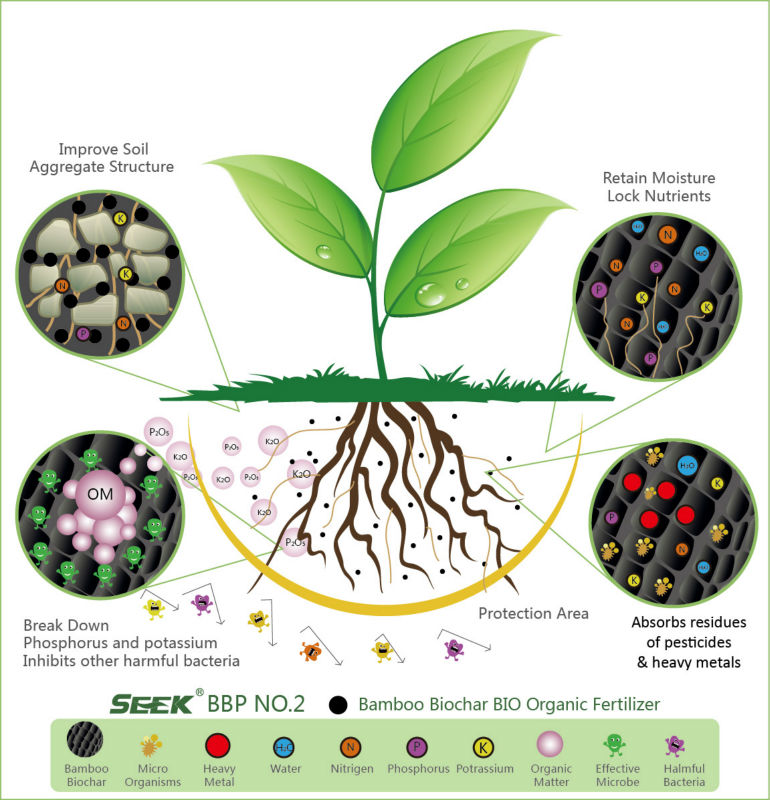
  • It holds essential nutrients in the soil longer.
    • Biochar actually 'absorbs' the nutrients, such as from a fertilizer or compost, and holds it in the soil which otherwise could wash away (i.e. nutrient leaching).  Less fertilizer used and less fertilizer washing into ground water is a good thing.
  • It retains water and microorganisms.
    • Biochar, being porous, helps soil retain water which could decrease the need for excess irrigation.  The pores also provide a healthy environment for the soil's needed microorganisms to live AND reproduce.  This makes dirt happy.  It helps the soil support the life within the soil. 
  • It helps aerate the soil and can improve soil structure.
    • Soil structure is super important, more on that here.  Our soil is very compact and, without such additives, too compact to grow root vegetables and even take in water.  (Yes, it is so compact water just runs off the surface.)  We rely on aerating additives such as compost and biochar to make our garden grow (how about you Mary, Mary quite contrary).  Oxygen in soil is important for the organisms living in it and plant roots need oxygen to sustain the plant.
I choose this picture only because of the evil little bad bacteria, but it lists other good things about biochar-

Second:  Apparently it is also good for the environment.
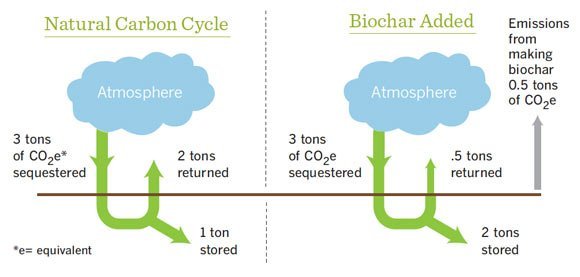
  • Biochar reduces green house gas emission into the atmosphere.
    • According to ALL the biochar resources out there, biochar holds carbon and other concerning 'green house gases' in the soil longer.  This is currently being researched more for helping lower carbon emissions into the atmosphere.  For more information on this, read HERE and HERE.
    • When animal waste is burned and made into biochar it reduces the methane gas (which is emitted naturally as waste decomposes) emissions into the atmosphere.
  • Biochar helps improve groundwater 
    • Biochar retains and holds fertilizers and/or other agrochemicals in the soil.  This keeps them accessible to the plant and keeps them from leaching into the groundwater.
Illustration from http://midwestpermaculture.com
-Quick note that biochar is NOT a new discovery, biochar has been discovered in soil in the Amazonian Basin back around 450 BC and AD 950.  Source of that tidbit is HERE: Terra Preta.

http://www.biochar.info/52/pix/comparison_biocharNpk_npk.jpg

So in conclusion, I will now summarize how we make biochar at our house: 

Step 1.  We get cold and burn wood in our wood stove on low oxygen.  I get warm and happy.
Step 2.  Our wood stove box starts overflowing with charcoal so much we have to clean it out.
Step 3.  We realize we made biochar for the garden and try to remember to store it somewhere outside where we can find it in the spring.
Step 4.  Spring comes and we find our accumulated biochar.
Step 5.  It is chunky and needs to be crushed, so Jonathan finds another use for his tractor.  (He runs over the biochar with it).


Step 6. We mix it with our compost (all our food scraps, dead leaves and animal droppings from past seasons).


Step 7.  We turn it in with the garden soil and plant stuff.  We use a organic fertilizer a few times during the season.

Step 8.  We watch our tomato plants get taller than us and wonder why?


Step 9.  We pick tomatoes the size of our daughter's head and Jonathan reminds me it is because he added biochar.

Step 10.  We eat our food.  Winter comes and we get cold again.  So we start burning wood in our wood stove on low oxygen.  We get warm and happy.  Repeat cycle.


Thursday, June 19, 2014

2014 Piglets Are Here!

We got our piglets a recently!  They are only 5 weeks old but already at a strong healthy weight and looking excellent.  We estimate they are somewhere between 20-30 lbs.
Our farmer friend who raises them usually decides when to wean by watching the mother.  He decides to separate them when the mother is looking stressed and tired and when she is becoming irritated and nipping at them (ie, the sow is ready for them to be weaned and is doing it herself).  From my understanding and reading, the sow is usually NOT successful at fully weaning her piglets herself.  Piglets are VERY persistent feeders and their quick growth is evidence of that.  When they are little they are constantly following their mother around waiting for her to lay down so they can nurse.  Once she does they hop right on eat, eat, eat.
Stock photo
Once the piglets get taller they are able to nurse from the mother even when she is not laying down.  Pig farmers will tell you they will pester the mother until she gets pretty irritated at them.... sometimes the mother will even get aggressive with the piglets to ward them off.  Mothers will lay flat on their bellies to keep the tits from the piglets.
Stock photo

A blog post from Sugar Mountain Farm in Vermont explained how they attempted to let the piglets wean naturally, he said they never did and had to intervene due to the mother getting "a bit peaked".

Most farmers wean their piglets between 5-10 weeks from my understanding.  Factory farms wean theirs around 10-15 days.
Piglets start on other sources of food around 4 or weeks..... usually this is feed.  Just like human babies they need more calories eventually than what is found in mother's milk.  Also, sow's milk is devoid of iron.  Therefore piglets being kept on a concrete floor will need an iron supplement.  Piglets with access to dirt will root and get their needed iron from the dirt.
Last, before I share our piglet's photos, I want to mention that I am researching and plan to blog about farrowing crates (stalls where sows are kept while giving birth and through the early days following labor).  Our farmer informed me that they are illegal to use in Massachusetts.  I understand both sides, but I don't think most other people do.  Stay tuned for that if interested.

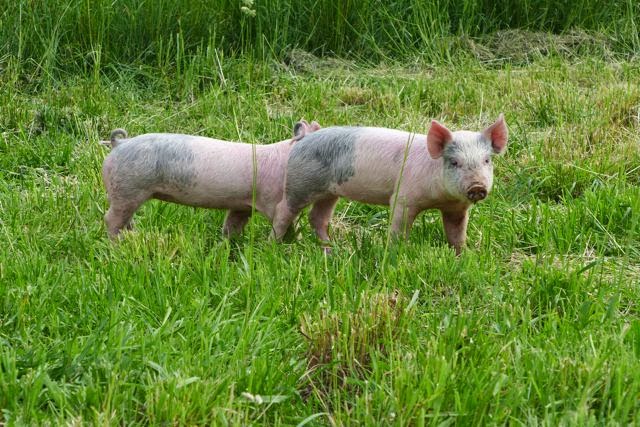
Now for the our piglet pictures!  Here are our two little gilts (gilt is a female pig before she becomes a mother).


We decided to get only females this year because in the past the females have been cleaner (only using the bathroom in the pasture and not near the food or bedding).  Maybe just a coincidence?  We will see how these do.


Just as previous years, we got Hampshire/Yorkshire crosses.  Long bodies mean more meat capacity.

Cute little hams.

Good hand sniffing form.... back of hand so there's nothing to possibly nip.


Already rooting, look at the little muddy noses-


I think someone else is as happy with these piglets as I am-


She does like animals.  Here is little lady last month at my parents farm.... who doesn't like a good game of peek-a-boo.