Showing posts with label quinoa. Show all posts

Wednesday, December 11, 2013

Quinoa Experiment in Conclusion

So as expected the quinoa did not get past its 'green stage' before a hard cold hit.  Unfortunately this killed my plants.  Since the quinoa came up later than planned this was expected but we figured we would give it a try.  Anyway, here is what's left (beautiful picture, right?)-


Quinoa CAN tolerate cooler weather, but not frosts before their green stage.  Quinoa is an early spring crop preferring cooler soil temps.  It can be stunted if many of its growing days are over 90 degrees F.  I attempted to start them in the late summer for a fall crop but they did not germinate immediately to get good growing in before the cold season.
Anyway, if you are interested in more here are my other posts on the quinoa experiment.  Seeds were from here.
Quinoa Growing Experiment and Fall Garden
Cover Cropping and Sneaky Quinoa

At the moment I am not planning on growing it next year.  I have moved onto wanting to grow naked oats instead.  We eat and use oats way more than we do quinoa.  We will see.

Something else in danger of frostbite is Penny.  Poor thing has went into molt having to get through cold nights with these naked spots.  She needs a scarf-


I have insulated the coop with straw but other than that they are on their own.  Last year they did just fine.  They are hardy chickens and the gradual cooling (with no heat in their coop) is good prep for the cold winter.  Only thing they get extra in the winter, besides extra straw in the coop, is cracked corn to build their body fat.  I have to break the ice out of their water daily but thats it.  I'm still getting eggs so the trip to the coop is needed anyway.
So dead plants and naked chicken necks..... thats all the excitement I can take for now.

Wednesday, October 23, 2013

Cover Cropping and Sneaky Quinoa

Yes, our quinoa is sneaky!!  More importantly it IS actually growing in our garden (I initially thought it did not germinate because of the soil temperature).  Here is the not so intriguing story....

I ended my previous post with a picture of us clearing out the garden to plant a cover crop.


While pulling up the remaining turnips and beets I noticed a new, so I thought, weed consistently growing in a row.  I skeptically declared to Jonathan it was my quinoa knowing there are some weeds that look similar.  So we decided to leave it and see what happens.  Here is my possible red quinoa, or at the least something in the same family (like lamb quarters maybe)-


Picture from my seed packet, notice the leaves-

Another picture of a young quinoa plant from the internet-


Here is a picture of the possible impersonator, whose leaves are edible I believe.  Wild lambs quarters-


Anyway, this is all probably very boring to most so I apologize.  It's exciting to me.  If anyone has experience growing quinoa please feel free share any information.
Back to cover cropping and why we are doing it.  We had a good year of harvest which we think is mostly due to the addition of lots of organic matter (composted cow manure) to our garden.  It greatly improved our soil's quality, especially the once horrible soil structure.
Cover cropping is when you sow a specific crop to improve the soil's quality.  For us we chose Winter Rye (yes, like the grain you find in rye bread).


After tilling up the ground we spread the seed just as you would grass seed (I got the Winter Rye seed from our local garden store, it was the one recommended for our area).


Then per my Dad's suggestion (since he does this sort of thing very often), we ran over it with our tractor to mash it down into the dirt.  For a smaller area, a simple raking around to cover the seed will do.


Now we let it grow all winter long.
Why cover crop (also called green manure), even if you have a small garden?  Cover crop suppress weeds, builds productive soil (by adding nutrients and organic matter after being tilled in in the spring) and help control pests and diseases.  Winter Rye specifically grows nice deep roots which provide many benefits to the soil (erosion control plus compaction prevention and the addition of organic matter in soil once the plant is dead).  It also helps preserve the nitrogen content in the soil instead of it leaching away into the ground water.  Winter Rye will grow and germinate in near freezing temperatures.  After well established it is very hardy and can tolerate temperatures as low as -33 degrees Fahrenheit (there is a minus in front of that number).
The crop then gets worked into the soil in the spring.  I cannot speak to how hard or easy it is to work up on a small scale without a tiller.  I would assume some work with a hoe would probably turn it over fine?  I have been told in our area that the crop will get stunted in the winter keeping it from re-seeding, but have read you should mow or work it in the soil before it gets to a re-seeding point.  I do know you should turn over any garden (cover crop or no cover crop) multiple weeks before planting in the spring to allow anything growing there to rot.  I will let you know how this goes for us.

To end with something worth looking at, here is baby girl feeding the pigs pumpkin scraps while wearing a purple sparkly necklace (irrelevant but a better ending than cover cropping stories)-

Pigs love all things squash, and baby girl thinks they should be served in style I guess-

Wednesday, September 25, 2013

Piggies Halfway, Fall Garden

Our pigs are halfway to their send off date (mid/end November).  They are about 16 weeks old, when we send them off they will be around 25 weeks old.  At 16 weeks old, we estimate they weigh a little over 100lbs.  If you spread out that weight gain across their whole life, that's like putting on 6.25lbs a week (assuming they start at 0lbs from birth which they don't).
Here are some shots of them enjoying being lazy, nosey and doing what they do best.... digging-

The 2013 piggie clan-

Getting their vitamin D (note: Piggies can sunburn which is one of the reasons they like to cover themselves in mud.  No one thinks elephants are gross for doing it.)-


Digging and finding vitamins and minerals-


Also to create a cool place to lay; nice cool earth-


Piggie kisses-


Though they are very intelligent, piggies don't talk :)... human talk anyway.  Piggies are very vocal though, they grunt and squeal regularly even if nothing is wrong-


If we were keeping a female for breeding I would keep this girl.  She is a good lookin' gilt-


I have to admit I am getting somewhat attached to this one.  She is the smallest and gets picked on, she  also seemingly has a knee problems.  Must reframe from naming her and making her my pet-


Kids enjoy visiting them and throwing them food scraps.  The piggies have had LOTS of vegetable leftovers from the garden.  They seem to love all our root vegetables and their greens the most (second to our sweet corn of course)-


Tangent-  just a reminder how fast time flies.  Look at baby girl just a year ago.  It's crazy how fast they grow.  Even through the challenging days of parenthood I MUST remember to enjoy ALL OF IT.


A quick shot of the garden.... still growing food.  The vines to the left of the drying corn stalks are the sweet potatoes (5 heirloom plants, 1 Georgia Jet).  I assume we will be digging them in the next month once the vines start to die (or before a hard freeze if that happens first)-


We still have turnips, leaf lettuce and beets doing well.  The recent weather has been ideal for them (cool and occasional rains)-


I finally picked my heirloom Calypso Beans (dried beans for soups and such).  They finished drying on the plant, maybe will get one meal worth out of them.


Quinoa update for those interested.  I delayed growing it until next year after multiple attempts to get the seeds to germinate properly.  Quinoa is not hard nor tricky to grow (or so I have read) so I think doing the suggested spring planting will prove to be a better idea.  My guess is the late summer soil was warmer than the seeds prefer.  Only concern is the hot summer days in mid summer here when temperature are in the 90s.  Apparently hot, hot days can stunt the plant.  Its worth a try though.  I also hope to plant 'naked' oats in the garden next year (to make our own steel cut oats)..... and hoping we can add a few meat lambs to our pasture. Yes, I am always dreaming about growing our little operation here.... don't worry my husband is aware. :)


Thursday, August 15, 2013

Quinoa Growing Experiment and Fall Garden

This year we are trying to grow quinoa.  Since quinoa apparently does NOT like temperatures above 90F degrees I thought I would try it as a late summer crop (because we had multiple days over 90 degrees in July this year).  Its growing time is between 90-120 days so we are hoping for a possible October harvest.  They can handle light frost especially if the seed (the part that you harvest and eat from the plant head) is past the green stage.

The plants are tall and quite lovely.  You can even eat their VERY nutritious leaves at young growth.

Quinoa is extremely popular because of the seed nutritional content, mainly the protein content is what interests people.

Quinoa is mostly grown in the Andean highlands of Bolivia and Peru but its recent popularity has inspired some regions in North America to try experimentation crops.  This popularity has also brought up controversy due to the rise of price thats been inflicted on the original growing regions.  Reports say those areas, which used quinoa as a dietary staple, can no longer afford it for themselves.
I am not an expert in this area and can't express an opinion one way or the other.  We thought we would try to grow it for economical reasons.  Currently, the cost is about $8/lb at my grocery store and not always available.  A packet of seeds is around $2.00 (which has enough seeds for 6+ pounds worth of harvest).

Anyway, I planted enough plants to harvest about 1 pound worth of seed.  If it works out we will try more next year and maybe even sell it.  Currently though, I am having trouble with getting it to germinate.  I will keep you updated as things progress, if they progress.

Along with quinoa I have planted our 'late summer' garden or short season and cool season plants.  We recently harvested beets and potatoes from this area.


In harvesting news, we are giving thanks for a good season so far.
Amish Paste tomatoes in the basket, Brandywine heirloom tomato still ripening on the vine-

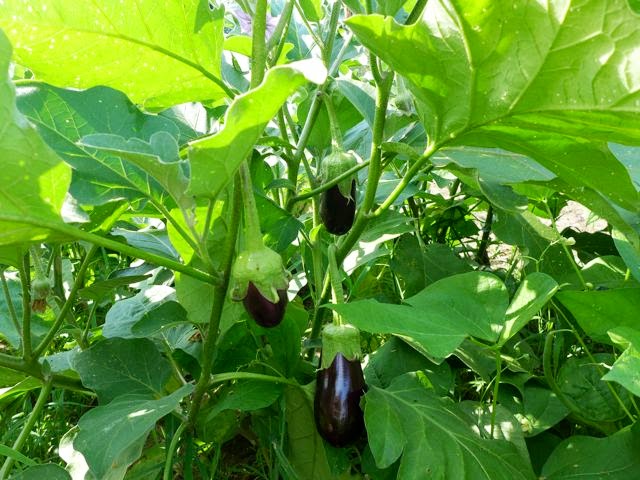
Lots of eggplants still growing-


First year of trying soybeans (for edamame) going well so far-

We had a good harvest from the blue potato plant the came back from last year.  As roasted, these potatoes are not as tasty as some other varieties.  They are more for potato salads I would say... but interesting to look at with their blue flesh.


I am itching to get a house update post on here soon.  Hopefully that will happen. :)