Showing posts with label cooking. Show all posts

Wednesday, July 23, 2014

Beets Are Beautiful

Some of you have already heard this story but I would like to share again for those possible beet haters.
First some beet photos to warm you up to them-

Lovely-

Beets modeling in a row-


How about if I add a little girl-


Does a pouty face help?


How about with a cat?

Yeah, the last one isn't so appealing.

Back to my story-
Beets used to taste like dirt to me.... literally.... they tasted exactly.like.dirt.  I had only tried home canned pickled beets and boiled/steamed beets.  Some people love these and that is great.  I did not.
That is until my husband, who was a beet lover before we met, insisted that we grow them and eat them regularly.  He liked them steamed and I just could not eat them (and I am NOT a picky eater, I will eat most anything).  So to save our marriage (*exaggeration) I tried roasting them instead since I knew roasting usually makes all vegetables sweeter.  It worked!  And our marriage was saved.... then this happened:

Yes, we became known as a beet loving family (notice the shirt, what did you think I meant?).

I was willing to continue to give beets a try because of their nutritional value.  More on that here.  Also, since it is a cool weather vegetable, you can plants them early in the spring for an early summer harvest.  Then plant something new in their place for the summer.  We also plant some beets late summer for a fall harvest.

So what do we do with the beets.  Like I said I roast them, like this-
Wash, crop tops to steam the greens (don't peel):


Drizzle them with some oil, seal them in a pouch and roast for around an hour at 375F (depends on size and amount):


Pierce with fork to ensure soft, let cool to touch and skins should slip right off:

Our favorite way of eating them is quartered with roasted almonds and feta or goat cheese.  Really good.  The kids even love these.  They are sweeter than roasted carrots, almost as sweet as roasted sweet potatoes.  Jonathan LOVES the beet greens steamed (yes, I used to think this was weird too).

The excitement of eating beets might cause problems with eye hand coordination.

There we go.

I have also substituted beets for carrots in shepherds pie.  We will also roast them with carrots.  Roasted beets and carrots are a classic combination.
Recently, I skinned and grated raw beets to make a slaw with aioli dressing.  I would assume there are other dressings that will work.  It was very good, kids were not as fond of this one though.
(Used red and golden beets)


I am sure there are many things you can do with them, like beet chips, but as insinuated before I am new to this beet cooking.  If you have a beet favorites please share.


Wednesday, October 30, 2013

Pig Lard vs. The World

Poor, poor lard.  For the past 50ish years its reputation has been smeared by MASSIVE misconceptions.  But it seems that it might be getting its well deserved come back.  If you are gasping at what I am saying, PLEASE continue reading my friends.

Depending on what generation you are from I know its hard to know who to believe when it comes to nutrition.  I mean, the 'expert's' opinions seems to keep changing, right?  Kind of but not really.....


First, what is lard 
Lard is the fat from a pig.  For cooking purposes it is rendered and solidifies into a form similar to shortening.  Lard typically is rendered from the back area (known as fat back) or the visceral fat from around the kidney/loin area (known as leaf lard).  Leaf lard is most likely what your grandmother or great grandmother used to make all her biscuits and pie crusts.  Its not hard to find an online forum where cooks are still saying that leaf lard is a superior product to making such (over butter AND shortening).  Leaf lard is more neutral in flavor than fat back lard.  Fat back lard is used more for frying purposes.


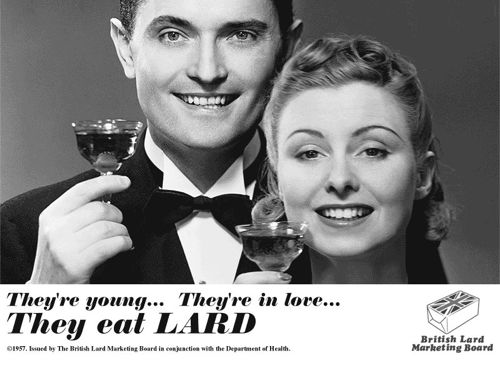
I am curious to know what role lard played in making this couple young and in love.

The Skinny On Fat

As you know, our bodies have to have fat (whether from an animal or a plant source).  Our brain, and hormones rely on fat to function.  Fat also helps the body to absorb nutrients, calcium, and the fat-soluble vitamins A, D, E, and K.  It is said that if you’re drinking non-fat milk enriched with vitamin D, your body will have a difficult time absorbing both the vitamin and the calcium since it lacks saturated fat to help the body do so.  This is just the surface of it, please read a smarter person's explanation HERE (in the introduction).

So fat is a must and very important, but here is the thing-

Not All Fats/Oils Are Created Equal

We can all agree that some fats are bad and some are good.  Research still continues to work on a 'cut dry' answer on this.  Let's back up in history for just a moment to get back to lard-
Animal fats started to get their bad rap in the 1950's when a study was published linking saturated fats with heart disease.  It was a faulty study but the vegetable oil industry greatly benefited from it. 
Not an actual ad, its an album cover.
People have since taken a second look since the general public's cardiovascular health does not seem to be improving.
Lard vs. Crisco and Margarine
One thing research of fats has agreed on across the board is that what replaced these animal fats (such as Crisco and margarine) are much more dangerous to our health.  This is because of the trans fat content (all agree trans fat is a bad guy, read more here if interested).  I know that in recent years they have developed margarine and shortening with less to no trans fat, but back when it replaced lard this was NOT the case.  According to this Harvard Health article, there was NEVER any solid evidence that using margarine over butter lowered your chance of developing heart disease.  Back to Lard, it contains little to NO trans fats.  Lard that has been heavily processed to give it longer shelf life might have small traces of trans fat, but from my research home rendered or lightly processed lard most likely will have even smaller traces (and even smaller traces if pasture raised).  Shortening (Crisco) which is now made, so called, 'trans fat free' most certainly still has trans fat.  If any product lists a partially hydrogenated oil in its ingredients (which Crisco does along with most margarines I believe) then it DOES contain trans fat.  It is able to claim trans fat free because the FDA allows products containing less than 0.5g in a serving size as trans fat free. (says so here).  The serving size for Crisco is 1 Tablespoon. I don't know about you but none of my recipes requiring shortening call for as little as 1 Tablespoon.  My grandma's biscuits recipe for instance uses up to 1/2 cup shortening, those trans fat grams add up.
Soooo, in regards to trans fat, lard easily wins the healthier prize-
Lard - 1,  Shortening and most margarines - 0

Lard vs. Butter

Let me start out by saying that I would rather spread delicious butter on my toast than lard (though some countries do use lard as a spread).  Put similar applications aside.... the argument here is centered around saturated fat.  Saturated fat from animal and plant sources provide a concentrated source of energy, provide building blocks for cell membranes and are needed for hormone production (just to name a few pros).  From my understanding though, this particular fat is the center of the most controversy: some believing it is a bad fat connected to heart disease, others believe it should be consumed regularly and quite essential to your health.  I will share that I believe if you are overall a healthy person I agree with the saturated fat advocates.  A few good sources supporting this found here and here (see Saturated Fat section).  I encourage you to research and decide for yourself.
As you know, all things have to be consumed in moderation, even good fats.  The major health sites recommend limiting dietary fat to no more than 20-35% of your daily calorie intake (per mayoclinic's article here).  So here is my quick undercut to butter (sorry dear, delicious friend).  Per tablespoon lard has 16% less saturated fat than butter (7g vs 5g).  Ramp that serving size up to 1 cups worth (needed for most pie crust recipes), lard has 37 less grams of saturated fat than butter.  Here's another quick punch- lard has double the monounsaturated fat (a very good fat for your health, agreed across the board) than butter.  Lard having 6g per tablespoon vs. butter's 3g (Crisco has 2.5g/tablespoon).
So in regards to healthy fat ratio and content-
Lard - 1, Butter - 0


Lard vs Olive Oil

Oh yes I did, I am totally going here.  It is well established that olive oil is a superior oil to consume for your health.  It is very high in that good fat we just talked about (monounsaturated fat) with 10g in 1 tablespoon.  It is also trans fat free in its natural state and low in saturated fat.  One concern some have with extra virgin olive oil is that when it is heated to its smoking point, it becomes unstable and changes in composition.  Some of it's health benefits are lost and it also forms trans fat when over heated.  Makes sense since this why over processed vegetable oil products have trans fat (such as shortening and margarine, ie trans fat is mostly man made from over processing).  Lard can only kick olive oil in the shin at this fight as its smoking point it not too much higher than regular olive oil.  (And I read that unless you are heavily deep frying in olive oil you are most likely NOT reaching its smoking point).  Lard IS more stable and has a longer shelf life than olive oil, therefore holding its nutritional value longer.  But one area that lard is way more nutritious than olive oil is the Vitamin D department.  Olive Oil has ZERO grams of vitamin D vs. pastured lard having up to 1000 IU of vitamin D per tablespoon.  This source is second to only cod liver oil... and again remember it has to be from pastured pigs (where pigs are foraging and getting their sunlight). According to the US Institute for Medicine, it is recommended for children and adults to receive 600 IU per day.  Vitamin D is super important to our health so I will still consider this victory over olive like a small slap in the face (sorry this post is so violent).
So in regards to the important vitamin D-
Lard - 1, Olive Oil- 0

"That'll do pig, that'll do".

Finally in conclusion, maybe you should look into the fats you are consuming.  Don't make your judgements until you do so.  And don't judge something until you do (like pork lard).  Also remember that store lard is NOT the same product usually, most likely containing the partially-hydrogenated fats as discussed before from the processing.
If you are one of those people who research which oil is best to put in your car for better performance (I did this back in my day of cool car ownership) or which conditioner makes you hair the most healthy (I did this too back when I had time to wash my hair).... THEN WHY IN THE WORLD NOT CARE WHAT FATS (or all foods in general) YOU PUT INSIDE YOUR BODY.  I think you will benefit much more with a healthy feeling body.  Sorry for the yelling, the kids were quite uncooperative this morning (yes, thats my excuse).

To end here are some pictures of my home rendered lard (from our pigs) and some products made from it-

Cut up leaf lard and rendered slowly in the crock pot-

Finished, cooled product-


Happy customer, most definitely makes biscuits fluffier than shortening (I recommend leaf lard and its mild flavor for this and pie crusts)-

I cannot take credit for this berry pie, our friend Topper made it.  I asked him to make one while visiting once since he makes one of the BEST pie crusts I have ever had!

Thursday, October 4, 2012

Experiment 2: Cooking With Pumpkins and Apples....

Please read:  This is my second experiment I've shared.  Its not what I typically use this blog for as I don't want people to think this is a brag blog.  Let me just say this..... Most days I do NOT have it together in terms of housekeeping, parenting, cooking, etc.  Here is the scene at my feet in the kitchen most afternoons-


But as with any job I continue to try and get better at it.  My goal is to save money when I can and these experiments are tailored around that goal.  I enjoy learning from other people so I want to share what I have learned too.
My first experiment was making homemade yogurt in a crock pot which turned out to be a big success, cost efficient and pretty easy.  I am still making yogurt almost every other week.... and believe me, if it wasn't worth it I wouldn't mess with it.

Adding to my experiments (hear me out on this one why its discussion worthy).....  cooking your own PUMPKIN, is it worth it?  The analysis proved yes- if you are using it for meals.  It's easily roasted (don't mess with the peeling thing, instructions linked here), which keeps the sweetness and nutrition.  Which brings me to my first reason WHY, they are  crazy nutritious.   This a huge reason why they're worth it and why I think its worth talking about.  They deserve to make more appearances than just in desserts and hot drinks.  Second, you get a good amount of food from just one.  And don't forget the seeds which are surprisingly super nutritious too.  Jonathan looooves seeds roasted.


Use a good cooking pumpkin (like pie or sugar pie pumpkin) though instead of a jack-o-lantern pumpkins.  You can use any though depending on what it's going into.  Some meal ideas (imagine the list if dessert items were added)-

  • mashed pumpkin as a side dish with a little butter and cinnamon
  • pumpkin soup
  • pumpkin chili
  • pumpkin bread
  • pumpkin rice pudding
  • pumpkin risotto (might have to peal it instead on this one)
  • pumpkin pancakes
  • pumpkin muffins
  • hello!! amazing pumpkin baby food puree
Don't be a hater until you try one of these.... and why wouldn't you if you're ok with pureeing this lovely squash into a pie.
I would love for anyone to share other pumpkin meal ideas and recipes, please do.

Just to quickly note other squash that I have learned to love and stay in season into the winter- Butternut and Acorn (I know there are so many amazing squash hybrids but these two work well for us).  They are cheap and I've been making lots of meals from them lately..... I've also noticed I have lost weight and I believe these meals are the reason... seriously..... tasty meals with little to no fat and are filling.  Just last week I tossed acorn squash slices in a paprika spice blend and roasted them-
 Put them with couscous and Jonathan and I added a parsley yogurt sauce (sounds weird but we liked it when we tried it).  Acorn squash is great with curry spices too because it has a sweetness.  Butternut, if roasted, is tasty enough by itself.

No complaints even from the sometimes picky toddler-


Don't neglect those SQUASHES people!!! :)

Gotta end with apples (good way to get a picking picture in here).


Making your own apple sauce.... is it worth it?  I would say, it depends?  Let me be clear why.... First, homemade applesauce is WAAAAYYYY more delicious.  Honestly, after eating homemade you might not want to eat the watered down store bought stuff again.  Oh my stars is it tasty.  I would assume homemade is healthier too because its less processed keeping those lovely apple nutritious qualities.  The con, homemade is more expensive.... but not too expensive to keep from doing it.   Plus, I would suggest owning a corer and peeler (though I do not and still completed the full task in less than 2 hours, processing time included) and definitely a food mill.


Bottom line, I will continue to make applesauce every year because its a fun thing to do to celebrate apple season... but I will continue to buy store applesauce in the off season because its cheap.
I would give about the exact analysis for making your own crock pot apple butter.  It as well is amazingly tasty..... Smuckers ain't got nothin'.  So again, fun to do to celebrate the season, way tasty but not cost effective.

If anyone found this interesting I am glad.  If not, sorry.  At least I have fun doing the experiments and eating the food.  :)  Feel free to share your apple and squash and/or other seasonal worth it and not worth its please!!!  Thanks!

Oh, and don't worry I will have dining room progress to share eventually.